
PVC fencing is not a good choice for livestock when fencing must handle high pressure, large pasture perimeters, uneven terrain, or frequent layout changes. While PVC is low-maintenance and animal-safe, its rigidity, higher repair costs, and limited scalability make it poorly suited for demanding, high-impact livestock environments.
Why This Question Matters
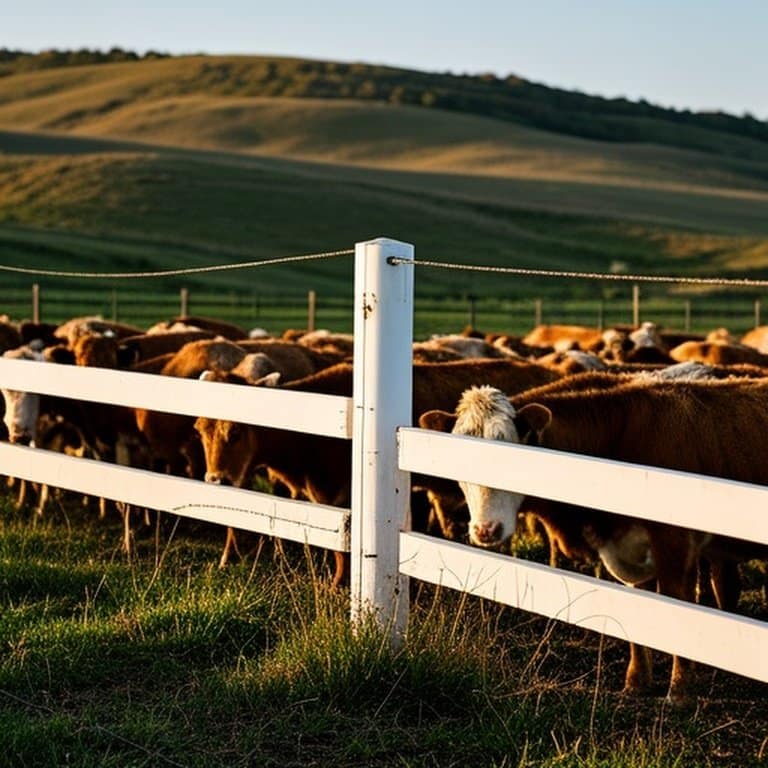
PVC fencing is often promoted as a long-term, hassle-free upgrade from wood or wire. For some livestock settings, that claim holds true—but for many working farms and ranches, it does not. Choosing PVC in the wrong situation can lead to cracked rails, costly repairs, and frustration when livestock pressure exceeds what the material is designed to handle.
This question matters because fencing failures don’t just cost money—they risk escapes, injuries, and lost time. Knowing when PVC fencing should not be used helps producers avoid expensive mistakes and select fencing systems that match real-world livestock behavior and operational demands.
Key Factors to Consider
- Livestock pressure: frequent leaning or crowding stresses rigid materials
- Fence length: high cost makes large installations impractical
- Terrain conditions: slopes and uneven ground increase failure risk
- Operational flexibility: permanent layouts limit adaptability
- Repair tolerance: component replacement is costly and time-sensitive
Detailed Explanation
PVC fencing performs best in controlled, low-pressure environments. It becomes a poor choice when livestock behavior or farm operations place continuous stress on the fence line. One of the biggest limitations is rigidity. Unlike wire fencing, PVC does not flex and redistribute force. When animals push, rub, or crowd—especially in groups—stress concentrates at joints and posts. Over time, this can cause cracking or structural failure rather than gradual deformation.
Large pasture fencing is another weak point. PVC fencing costs significantly more per foot than wire-based systems, making it financially impractical for long runs. Beyond material cost, installation and repair become increasingly complex as fence length increases. A single damaged section often requires replacing entire panels or rails rather than making quick field repairs.
Terrain further limits PVC’s usefulness. Sloped or uneven ground increases post movement and joint stress. While skilled installation can mitigate some issues, PVC fencing remains less forgiving than wire systems that naturally adapt to ground variation. In regions with frost heave, erosion, or shifting soil, maintenance risks increase substantially.
Operational flexibility is also a concern. Farms that use rotational grazing, temporary paddocks, or frequently reconfigure fencing benefit from materials that can be moved, tensioned, or adjusted easily. PVC fencing is designed for permanence. Once installed, changes are labor-intensive and costly, making it unsuitable for dynamic management systems.
In short, PVC fencing fails not because it is low quality, but because it is often used outside its intended role. High-pressure livestock, large-scale containment, and variable terrain expose its structural and economic limitations.
How Cattle Behavior Affects This Choice
Cattle behavior is one of the most common reasons PVC fencing underperforms. Cattle naturally lean, scratch, and press against fences—especially in groups. In high-traffic areas such as water points, feed zones, and gates, pressure builds repeatedly in the same locations.
PVC fencing does not flex to absorb this force. Instead, stress transfers to joints, rails, and posts. Over time, this leads to cracking or connection failure rather than gradual wear. Farms with calm cattle and low stocking density may never see these issues, but operations with active herds often do. When cattle behavior involves frequent physical contact, PVC fencing becomes a higher-risk choice compared to wire-based alternatives.
Calves vs Mature Cattle Considerations
PVC fencing is far more forgiving with calves or lightweight livestock. Lower body weight reduces impact forces, allowing the fence to remain intact with minimal stress. This makes PVC viable in calving pens or small holding areas.
Mature cattle change the equation entirely. Their mass and strength dramatically increase load on rails and posts. One strong push or group surge can cause damage that requires full component replacement. For operations dominated by mature livestock, PVC fencing quickly moves from low-maintenance to high-risk.
Terrain, Visibility, and Pressure Zones
PVC fencing struggles on uneven or sloped terrain. Posts must remain perfectly aligned to prevent stress buildup, which is difficult on hillsides or irregular ground. Wire fencing naturally adapts to these conditions.
Pressure zones are another weak spot. Corners, gates, and transitions require reinforcement that often eliminates PVC’s simplicity and cost advantage. While visibility is excellent—reducing accidental collisions—it does not offset structural limitations in high-stress locations.
When This Works Well
- Small, permanent livestock enclosures
- Low-density or calm animals
- Flat terrain with stable soil
- Farms prioritizing appearance and safety
- Areas with minimal physical contact
When This Is Not Recommended
- Large pasture perimeters
- High-density or high-movement herds
- Uneven, rocky, or shifting terrain
- Rotational grazing systems
- Operations requiring fast, low-cost repairs
Alternatives or Better Options
High-tensile wire fencing provides strength, flexibility, and scalability at lower cost.
Woven or barbed wire fencing allows fast repairs and adapts well to terrain.
Electric fencing reduces physical stress by training livestock behaviorally.
Hybrid systems using PVC only in visible or safety-critical zones often deliver better results than full PVC installations.
Cost, Safety, and Practical Notes
PVC fencing is safest when used selectively and strategically. Its smooth surfaces reduce injury risk, but failure tends to be sudden rather than gradual. Repairs require full component replacement, increasing downtime and cost.
From a practical standpoint, PVC fencing should be avoided in situations where flexibility, scalability, and resilience matter more than appearance. Farms that understand these limits and use PVC only where it excels see better long-term outcomes.
Quick Takeaway
PVC fencing is not ideal for large, high-pressure, or flexible livestock systems—but works well when used selectively in low-stress, permanent applications.