
Short Answer
To keep fence posts straight while setting them, position the post using a level on two adjacent sides, brace it temporarily, and backfill in small, compacted layers while checking alignment repeatedly. Maintaining vertical alignment during every stage — placement, backfilling, and tamping — prevents lean, twist, or shifting before the soil or concrete fully stabilizes.
Why This Question Matters
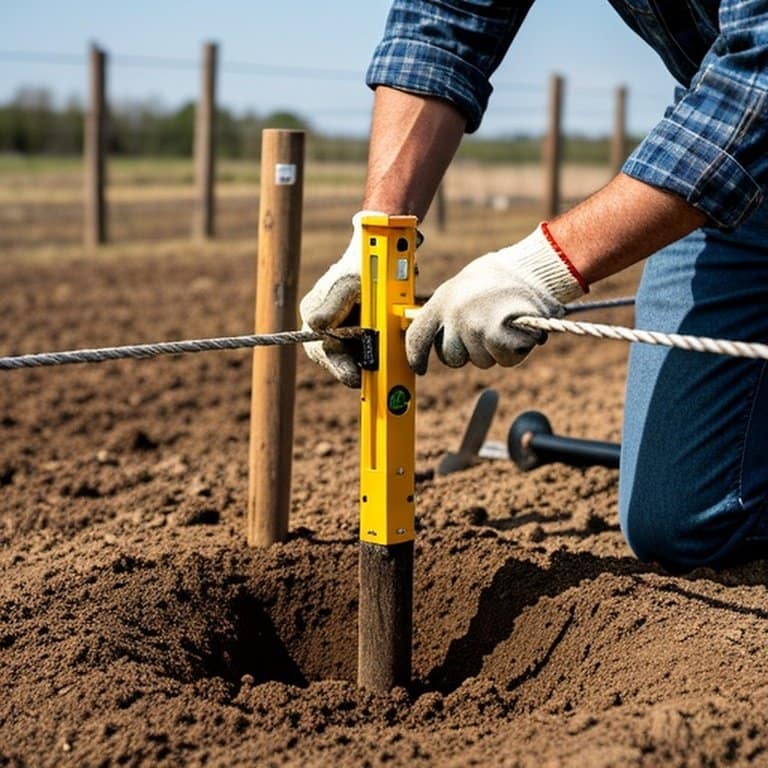
A fence is only as straight as its posts. Even a slight lean becomes visually obvious once wire or rails are attached. Worse, crooked posts weaken the entire fence line by transferring uneven tension across sections.
Many alignment problems don’t happen after installation — they happen during installation. Posts shift while backfilling, rotate slightly during tamping, or settle off level before concrete cures. Once the fence wire is attached, correcting a crooked post becomes difficult and time-consuming.
Understanding how to control alignment during installation ensures long-term structural stability, professional appearance, and balanced fence tension.
Key Factors to Consider
- Hole diameter relative to post size
- Soil stability and drainage conditions
- Whether using gravel, soil, or concrete
- Fence type and expected wire tension
- Use of bracing or temporary supports
Detailed Explanation
Keeping a fence post straight begins before backfilling. After digging the hole to proper depth, place the post in the center of the hole with even spacing around all sides. Use a 4-foot level or post level tool to check vertical alignment in two directions — front-to-back and side-to-side.
Temporary bracing is highly effective. Stakes driven into the ground and lightly screwed or clamped to the post prevent movement during backfilling. This is especially helpful when working alone or in loose soil conditions.
Backfill in 4–6 inch layers, tamping firmly after each layer. Never fill the entire hole at once. As you compact each layer, recheck vertical alignment. Minor adjustments are easy early but nearly impossible once fully compacted.
If using concrete, confirm alignment immediately after pouring and again within the first 10–15 minutes. Concrete does not prevent shifting during the initial setting period.
Finally, sight down the fence line from a distance before moving to the next post. A straight row visually confirms alignment and prevents cumulative deviation along long fence runs.
Consistent checking and controlled compaction are the keys to maintaining straight posts during installation.
How Cattle Behavior Affects This Choice
Cattle often push or rub against fences, especially along perimeter lines. A post that begins slightly off-plumb will lean further under repeated pressure.
Ensuring posts are perfectly vertical during installation increases resistance against lateral force from livestock movement.
Calves vs Mature Cattle Considerations
Calves exert minimal force and may not reveal slight alignment issues. Mature cattle, however, can amplify small installation errors over time.
For fencing designed for adult livestock, precise alignment is more critical for long-term performance.
Terrain, Visibility, and Pressure Zones
Posts on slopes are more prone to visual misalignment. Gravity and soil movement can exaggerate slight installation errors.
Corner posts, gate posts, and high-visibility fence lines require extra attention to alignment for both structural and aesthetic reasons.
When This Works Well
- Moderate soil firmness with good compaction
- Straight fence runs with string line guidance
- Proper hole sizing with minimal excess space
- Low wind conditions during installation
- Use of temporary bracing supports
When This Is Not Recommended
- Extremely loose or sandy soil without stabilization
- Oversized holes that allow excessive movement
- High-wind environments during concrete curing
- Sloped terrain without proper sight-line checks
- Installing without a level or alignment reference
Alternatives or Better Options
String Line Alignment Method
Running a tight string line between corner posts ensures every line post follows a consistent straight reference.
Post Levels and Clamps
Specialized post levels attach directly to the post and allow hands-free alignment checks during backfilling.
Driven Steel Posts
Driving steel posts instead of setting them in dug holes reduces alignment drift caused by backfill shifting.
Cost, Safety, and Practical Notes
Using a level and simple bracing adds minimal cost but significantly improves fence quality. A small investment in alignment tools prevents expensive rework later.
Avoid standing directly over the hole while tamping to prevent accidental shifts in alignment. Check plumb frequently instead of assuming the post has not moved.
Once wire tension is applied, correcting misaligned posts may require removal and reinstallation. Careful alignment during setting saves labor and preserves fence integrity.
Quick Takeaway
Keeping fence posts straight requires controlled placement, temporary bracing, layered backfilling, and repeated alignment checks. Use a level in two directions and sight down the fence line before moving on. Early precision prevents long-term leaning and structural imbalance.