
Short Answer
To prevent fence posts from frost heave, install posts below the local frost line, improve drainage with gravel backfill, avoid rigid concrete collars in freeze-prone soil, and use proper bracing to distribute tension forces. Frost heave is driven by water expansion in freezing soil, so depth and drainage are the most reliable long-term solutions.
Why This Question Matters
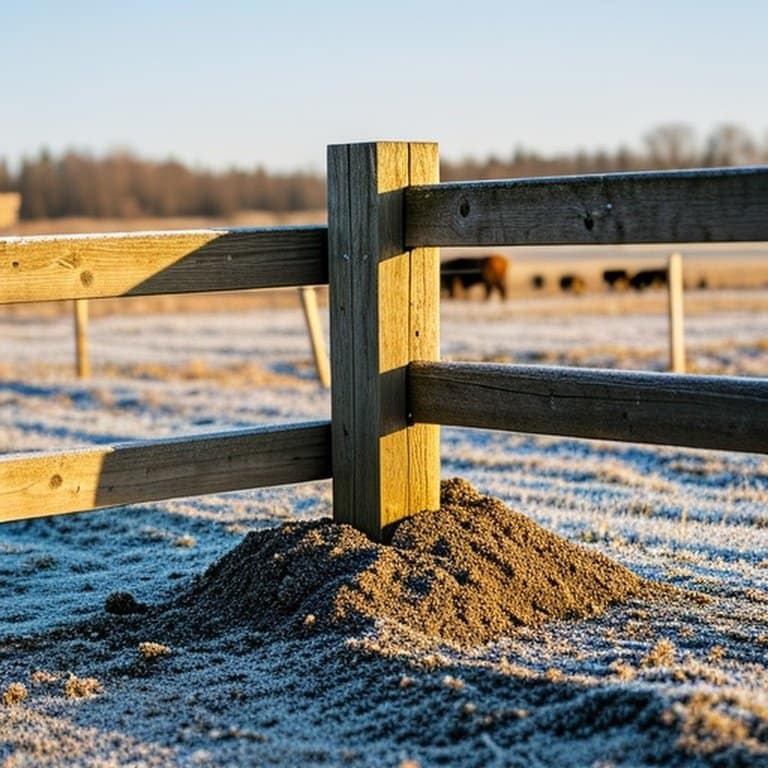
Frost heave is one of the most common causes of fence failure in cold climates. When water in the soil freezes, it expands and pushes upward against buried objects — including fence posts. Over one winter, posts can lift slightly; over multiple freeze–thaw cycles, they tilt, loosen, and compromise wire tension. Once alignment shifts, gates stop closing properly, high-tensile lines sag, and entire fence sections lose structural integrity. Many livestock owners mistake this movement for poor material quality when the real issue is improper installation depth or drainage. Understanding how frost heave works allows you to prevent gradual structural damage instead of repeatedly repairing the same leaning posts every spring.
Key Factors to Consider
- Install posts deeper than the regional frost depth
- Improve soil drainage to reduce water retention
- Use gravel backfill instead of full concrete encasement
- Reinforce corners and brace assemblies properly
- Avoid smooth post surfaces that allow upward soil grip
Detailed Explanation
Frost heave occurs when moisture in the soil freezes and forms ice lenses beneath the surface. As the water expands, it pushes upward against any object embedded in the ground. Fence posts are especially vulnerable because they create vertical resistance points in soil layers. If posts are installed above the frost line, frozen soil beneath them acts like a hydraulic lift, gradually forcing them upward during winter.
Depth is the primary defense. Posts should extend below the maximum frost penetration for the region. When the base of the post remains in stable, unfrozen soil, upward expansion forces are significantly reduced. This anchoring effect prevents seasonal lifting and maintains long-term alignment.
Drainage is the second critical factor. Frost heave requires moisture. Soil with poor drainage — particularly clay-heavy soil — retains water that later freezes and expands. Replacing native soil around the post with compacted gravel reduces water accumulation and improves vertical stability. Gravel allows water to drain away instead of collecting and forming ice layers around the post shaft.
Concrete is often misunderstood in frost-prone regions. While concrete can stabilize posts in warm climates, a full rigid collar around a post in freeze-prone soil can actually increase frost grip. When the soil freezes, it can bond to the concrete surface and lift the entire mass upward. In many cold-climate installations, a gravel base with partial concrete footing below frost depth performs better than a surface-level concrete plug.
When depth, drainage, and structural bracing are properly addressed, frost heave becomes manageable rather than inevitable.
How Cattle Behavior Affects This Choice
Cattle increase stress on frost-affected posts, particularly during winter clustering. When animals gather near windbreaks or feeding areas, repeated lateral pressure amplifies any post movement caused by frost heave. A post that has lifted even one inch may begin leaning under livestock pressure.
If brace assemblies are not reinforced, shifting corner posts can lead to progressive tension loss along entire fence runs. High-tensile systems rely heavily on stable anchor posts. In frost-prone regions, preventing vertical lift is only part of the solution — distributing lateral livestock pressure through proper bracing ensures long-term performance.
Calves vs Mature Cattle Considerations
Calves may exploit small gaps created by post lift. When frost heave slightly raises bottom wires, clearance near ground level increases. Younger animals can slip through these openings before the issue becomes visually obvious.
Mature cattle exert greater lateral force. If a post has been loosened by winter soil movement, impact pressure from a full-grown animal can accelerate tilt. Frost prevention strategies must therefore support both ground-level containment and high-load resistance.
Terrain, Visibility, and Pressure Zones
Low-lying or poorly drained terrain increases frost heave risk. Areas where water naturally collects — such as valleys, depressions, or compacted feeding zones — are more vulnerable. Identifying these pressure zones before installation allows for deeper post setting or enhanced drainage.
Snow cover also masks early warning signs. Leaning posts may not be immediately visible when ground contours are buried. Routine early-spring inspections are critical in frost-prone regions to correct minor shifts before tension systems destabilize further.
When This Works Well
- Posts installed at least 6–12 inches below frost depth
- Compacted gravel backfill improving water drainage
- Reinforced H-brace or diagonal brace corner systems
- Well-drained soils with minimal clay content
- Regular seasonal inspection and tension adjustment
When It Is Not Recommended
- Shallow post setting in known freeze-thaw regions
- Full surface-level concrete collars in heavy clay soils
- Poor drainage sites without gravel backfill
- Lightweight corner assemblies under high tension loads
- Wetland or saturated ground without specialized design
Alternatives or Better Options
Helical Pile Anchors
In severe frost regions, helical ground anchors provide deep mechanical stability below frost penetration. They resist vertical lift effectively but require specialized installation equipment.
Steel T-Posts with Deep-Driven Installation
Driven steel posts can reduce frost bonding surface compared to rough wood. When installed below frost depth, they offer strong vertical resistance with minimal soil adhesion.
Floating Fence Design with Adjustable Tension
In some operations, designing fence systems with seasonal re-tension capability allows minor frost movement without structural damage, particularly in long high-tensile runs.
Cost, Safety, and Practical Notes
Installing below frost depth increases labor and auger time but prevents recurring repair expenses. Gravel backfill adds moderate material cost yet significantly reduces long-term post movement. Attempting to save on depth often leads to repeated resetting costs every spring.
From a safety standpoint, leaning posts create unpredictable tension distribution. Sagging wires increase entanglement risk for livestock and handlers. Frost-heaved corner posts can destabilize entire fence lines if not corrected early.
Practically, prevention is far less expensive than correction. Resetting multiple posts after freeze–thaw cycles often requires complete tension release, brace reconstruction, and realignment. Proper installation at the outset avoids this cascading repair cycle.
Quick Takeaway
Frost heave is caused by freezing moisture lifting posts from below. The most reliable prevention strategy is simple but non-negotiable: install below frost depth, improve drainage with gravel, and reinforce brace assemblies. Depth and drainage stop vertical lift — proper bracing stops structural failure.