
Barbed Wire Fencing Guide
Overview
Barbed wire fencing remains one of the most widely used and cost-effective livestock containment systems for large pastures, ranches, and perimeter boundaries. It is especially common in cattle operations where durability, visibility, and low material cost are primary concerns.
This Barbed Wire Fencing Guide explains when barbed wire is appropriate, when it should be avoided, how many strands are required, ideal post spacing, installation methods, safety considerations, and long-term cost expectations. It is designed for ranchers, small farm owners, land managers, and anyone evaluating traditional wire fencing systems.
This guide focuses specifically on barbed wire fencing systems and comparisons. For electric fencing, woven wire, or livestock-specific systems, refer to the Cattle Fencing Guide, Goat Fencing Guide, and Sheep Fencing Guide.
YouTube search query: “how to install barbed wire fence step by step ranch tutorial”
What This Guide Covers
What Is Barbed Wire Fencing and When Should You Use It?
Barbed wire fencing consists of two twisted steel wires with sharp barbs spaced at regular intervals, typically every 4–5 inches. The barbs create a psychological and physical deterrent that discourages livestock from pushing through or leaning against the fence.
Barbed wire is most appropriate for cattle containment on large pastures, ranch perimeter fencing, and situations where low material cost per linear foot is a primary consideration. It works well in open range conditions where animals have ample space and are less likely to crowd fence lines. For detailed use case analysis and system comparisons, visit the What Is Barbed Wire Fencing guide.
What Is Barbed Wire Fencing and When Should You Use It?
Is Barbed Wire Fencing Safe for Livestock?
The safety of barbed wire fencing for livestock varies significantly by species. It is widely considered acceptable for cattle when properly installed and maintained at correct tension. Cattle have thick hides and generally learn to respect barbed wire boundaries without significant injury.
However, barbed wire poses greater risks for horses, which can suffer severe lacerations if they run into or become tangled in the fence. Goats and sheep are also more vulnerable to injury due to their wool, smaller size, and tendency to push through gaps. For species-specific safety evaluations and alternative recommendations, see the Is Barbed Wire Safe for Livestock guide.
Is Barbed Wire Fencing Safe for Livestock?
How Much Does Barbed Wire Fencing Cost per Acre?
Barbed wire fencing cost per acre depends on several factors including wire quality, post spacing, number of strands, terrain complexity, and labor rates. Material costs typically range from $0.75–$1.50 per linear foot for a standard 4-strand system with posts every 10–12 feet.
Total installed costs including labor often reach $1.50–$3.00 per linear foot, making barbed wire one of the most economical options for large acreage projects. However, ongoing maintenance costs should be factored into long-term budgeting. For comprehensive cost breakdowns and budgeting tools, consult the Barbed Wire Cost Analysis guide.
How Much Does Barbed Wire Fencing Cost per Acre?
Barbed Wire vs Woven Wire: Which Is Better?
The comparison between barbed wire and woven wire involves trade-offs between cost, safety, durability, and livestock type. Barbed wire has lower material costs and faster installation but offers less containment security and poses greater injury risks for certain animals.
Woven wire provides superior physical containment, better predator resistance, and improved safety for horses, goats, and sheep. It costs more initially but often requires less maintenance and provides longer service life. For detailed side-by-side comparisons and decision frameworks, see the Barbed Wire vs Woven Wire guide.
Barbed Wire vs Woven Wire: Which Is Better?
How Many Strands of Barbed Wire Do You Need?
The number of barbed wire strands needed varies by livestock type, animal size, and containment goals. Standard cattle fencing typically uses 4–5 strands with spacing of 10–12 inches between wires, with tighter spacing near the bottom to prevent calves from crawling under.
Three-strand systems may be sufficient for mature cattle in low-pressure situations, while 5–6 strands work better for mixed herds including calves or in areas where animals crowd fence lines. More strands increase material and labor costs but improve containment reliability. For strand count recommendations by species and situation, refer to the How Many Strands guide.
How Many Strands of Barbed Wire Do You Need?
Can Barbed Wire Be Used as a Perimeter Fence?
Barbed wire as perimeter fencing is common on ranches and large cattle operations where it defines property boundaries while containing livestock. It works well for perimeter applications when neighboring properties have compatible land uses and similar livestock operations.
However, barbed wire perimeter fencing near residential areas, public roads, or recreational properties may face legal restrictions or liability concerns. Some jurisdictions require specific setbacks or alternative fencing types near certain boundaries. For perimeter planning strategies and legal considerations, see the Barbed Wire Perimeter Fence guide.
Can Barbed Wire Be Used as a Perimeter Fence?
Common Problems with Barbed Wire Fences
The most common problems with barbed wire fences include sagging wires from improper tension, broken strands from animal pressure or weather stress, leaning posts due to inadequate depth or bracing, and rust that weakens wire integrity over time.
Temperature fluctuations cause wire expansion and contraction that gradually reduces tension, requiring periodic re-tightening. Vegetation growth that touches wires can accelerate rust, while snow load or animal impact can break strands. For troubleshooting guides and preventive maintenance strategies, see the Common Problems guide.
Common Problems with Barbed Wire Fences
Is Barbed Wire Legal in All Areas?
Barbed wire fencing legality varies by jurisdiction, with some areas restricting or prohibiting its use near residential zones, public roads, recreational trails, or property boundaries. Rural agricultural areas typically allow barbed wire without restriction, while suburban and urban areas often have specific regulations.
Liability concerns also affect barbed wire use—property owners may be held responsible for injuries to people or animals that contact their fencing. Some regions require warning signs or specific height limits. For regulatory guidance and compliance information, consult the Is Barbed Wire Legal guide.
Is Barbed Wire Legal in All Areas?
How Long Does Barbed Wire Fencing Last?
Barbed wire fencing lifespan typically ranges from 15–25 years depending on wire quality, climate conditions, maintenance practices, and animal pressure. High-quality galvanized wire in dry climates with proper maintenance can exceed 25 years, while lower-grade wire in humid or coastal environments may deteriorate significantly faster.
Rust is the primary factor limiting barbed wire lifespan, with corrosion weakening wire until it breaks under normal tension. Posts often outlast the wire, especially treated wood or metal posts. For lifespan projections and maintenance planning, see the How Long Does Barbed Wire Last guide.
How Long Does Barbed Wire Fencing Last?
When Should You Avoid Using Barbed Wire?
There are several situations where you should avoid using barbed wire fencing. Never use barbed wire for horse containment due to the high risk of severe lacerations and entanglement injuries. It is also inappropriate near public access areas, playgrounds, or heavily trafficked zones where people may contact the fence.
Barbed wire provides minimal predator protection and should not be the sole defense in areas with significant predator pressure. Small livestock like goats and sheep are also better contained with woven wire or electric fencing. For alternative fencing recommendations, see the When to Avoid Barbed Wire guide.
When Should You Avoid Using Barbed Wire?
Common Decision Scenarios
If You Need the Lowest Upfront Cost
Barbed wire is often the cheapest fence type per foot for large acreage projects, making it attractive for budget-constrained operations. Material costs are significantly lower than woven wire, and installation is faster because fewer line posts are needed.
However, consider long-term maintenance costs when evaluating total ownership expense. Barbed wire typically requires more frequent repairs and tension adjustments than some alternatives. For comprehensive cost comparisons, see the Fence Cost & Budgeting guide.
Cheapest Livestock Fencing Options
If You Are Fencing Cattle on Large Pasture
For cattle fencing on large pastures, traditional multi-strand barbed wire systems provide reliable containment at economical cost. Four to five strands with proper tension and post spacing effectively contain cattle while allowing good visibility across the property.
Barbed wire works particularly well in open range situations where cattle have ample space and are less likely to crowd or pressure fence lines. For cattle-specific fencing recommendations and system comparisons, see the Cattle Fencing Guide.
If You Have Horses
Barbed wire is generally not recommended for horses due to the high risk of serious injury. Horses can suffer severe lacerations, particularly on legs and chest, if they run into barbed wire or become entangled while rolling or playing near the fence.
Safe horse fencing alternatives include smooth wire, wooden board fencing, electric tape or rope, or specialized horse fence products. For horse-safe fencing options and design recommendations, see the Horse Fencing Safety guide.
If Predator Pressure Is High
Barbed wire alone is rarely sufficient for predator control because its wide strand spacing allows predators to squeeze through, and it provides no protection against digging or climbing. Coyotes, foxes, and dogs can easily navigate between strands or dig underneath.
In high predator areas, combine barbed wire perimeters with electric offset wires, use woven wire with barbed wire reinforcement, or implement dedicated predator fencing systems. For predator exclusion strategies, see the Wildlife & Predator Fencing Guide.
If You Want Minimal Maintenance
For minimal maintenance requirements, high-tensile smooth wire or properly installed woven wire often require less ongoing intervention than barbed wire. High-tensile wire maintains tension better through temperature changes and requires fewer line posts due to its superior strength.
While barbed wire has lower initial costs, it typically needs more frequent re-tensioning, strand replacement, and post repairs over its service life. For low-maintenance fencing comparisons, see the High-Tensile Wire Guide.
Key Design & Planning Considerations
Fence Height & Spacing
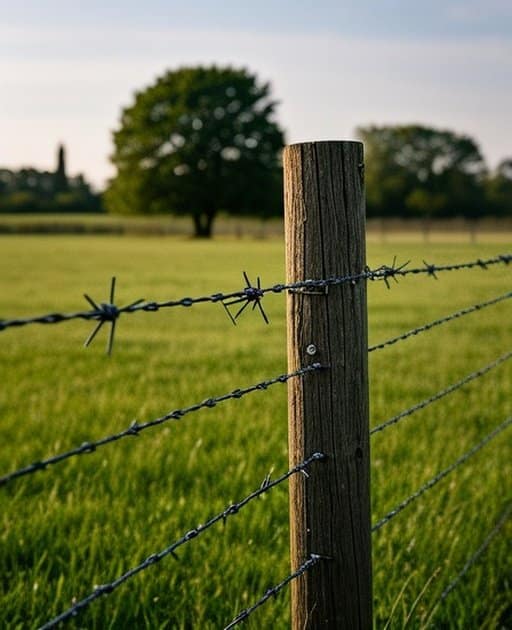
Barbed wire fencing typically ranges from 42–54 inches in total height depending on livestock type and containment goals. Cattle fencing commonly uses 48-inch height, while perimeter fencing may be taller to improve visibility and discourage testing.
Strand spacing is closer near the bottom—typically 8–10 inches for the bottom wire above ground, then 10–14 inches between subsequent strands. This configuration prevents calves and smaller animals from slipping underneath while maintaining economical material use. Post spacing usually ranges from 8–12 feet on flat terrain, with closer spacing on slopes or in areas with heavy animal pressure. For detailed spacing recommendations, see the Fence Planning Basics guide.
Safety Factors
Barbed wire can cause cuts and lacerations, especially for horses, goats, and sheep that may panic when caught or entangled. It is generally considered acceptable for cattle operations when properly installed and maintained at correct tension—loose, sagging barbed wire presents significantly greater injury risk.
Avoid using barbed wire in high-traffic handling areas, near gates where animals congregate, or in locations where people regularly access pastures. Proper tension reduces sagging that animals might step over or become caught in. For livestock safety planning, consult the Barbed Wire Safety guide.
Cost & Maintenance
Barbed wire is inexpensive initially with material costs typically 40–60% lower than woven wire, but it requires ongoing maintenance due to wire stretching, corrosion, and animal pressure. Annual inspection helps identify and repair problems before they escalate into major failures requiring complete section replacement.
Long-term costs include periodic re-tensioning, strand replacement as rust weakens wire, post straightening or replacement, and vegetation control near fence lines. For lifecycle cost planning and maintenance budgeting, see the Fence Cost & Budgeting guide.
Installation Complexity
Barbed wire installation requires stretching tools, strong corner braces, and correct tensioning technique to prevent premature failure. Proper installation demands attention to post depth, brace strength, wire tension, and spacing consistency.
Corner and gate posts must be set deeper and braced more heavily than line posts because they carry the full tension load from multiple directions. Improper installation causes early sagging, broken wires, and leaning posts. For step-by-step installation guidance, see the Fence Installation Guide.
Legal & Boundary Considerations
Some regions regulate barbed wire near public areas, residential zones, recreational trails, or property boundaries adjacent to non-agricultural uses. Rural agricultural areas typically permit barbed wire without significant restriction, while suburban and urban zones may prohibit or limit its use.
Always verify local setback requirements and liability laws before installation. Property line disputes can arise if barbed wire is installed too close to boundaries or if shared fence responsibilities are unclear. For legal planning and compliance guidance, see the Local Fence Laws & Regulations guide.
Related Fence Systems
- Woven Wire / Field Fence – Superior containment with better safety profile
- Electric Fence Installation – Behavioral deterrence systems
- Fence Cost & Budgeting – Comprehensive cost planning tools
- Fence Planning Basics – Layout and design fundamentals
- High-Tensile Wire – Low-maintenance smooth wire alternative
Frequently Asked Questions
Is barbed wire fencing safe for cattle?
Yes, barbed wire is commonly used for cattle when properly installed and maintained at correct tension. Cattle have thick hides and generally learn to respect barbed wire boundaries without significant injury.
How many strands of barbed wire are needed?
Typically 4–5 strands for cattle depending on containment needs, animal size, and whether the herd includes calves. Three strands may suffice for mature cattle only, while 5–6 strands improve security for mixed herds.
Can barbed wire stop predators?
Barbed wire alone does not effectively stop predators without electric reinforcement or woven wire backing. Wide strand spacing allows predators to squeeze through or dig underneath.
How long does barbed wire fencing last?
15–25 years depending on wire quality, climate conditions, and maintenance practices. Galvanized wire in dry climates with regular maintenance can exceed 25 years.
Is barbed wire cheaper than electric fencing?
Barbed wire typically has lower upfront material costs, but maintenance requirements can increase long-term expense. Total cost comparison depends on project scale, terrain, and maintenance capacity.
Final Recommendations
Barbed wire fencing remains one of the most economical solutions for large cattle pastures and ranch perimeter fencing where low material cost and rapid installation are priorities. However, it is not ideal for horses, goats, sheep, or areas with high predator pressure without additional reinforcement.
Choose barbed wire if your priority is low upfront cost and large acreage containment for cattle. Consider woven wire or electric fencing where safety, predator resistance, or containment of smaller livestock are more critical considerations.
Use the linked guides above to compare cost, lifespan, and safety factors before finalizing your fencing system. Proper planning, correct installation, and regular maintenance will maximize the value and service life of your barbed wire fence investment.