PVC or plastic fencing can be used in large livestock areas, but it is rarely the most practical or cost-effective choice. While PVC performs well in small, controlled spaces, its higher cost, limited flexibility, and repair challenges make it less suitable for large perimeters compared to wire-based fencing systems.
Why This Question Matters
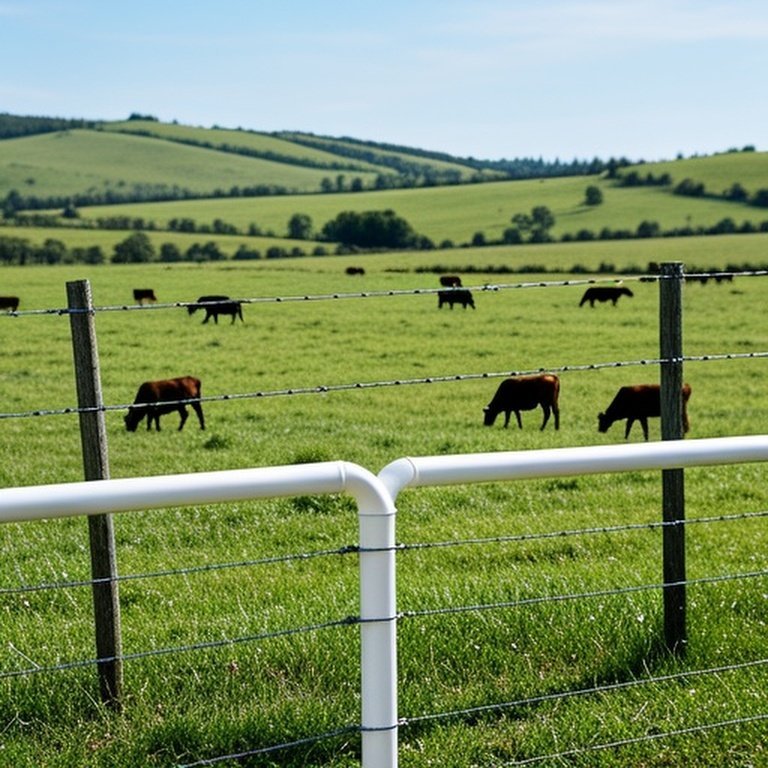
Large livestock areas demand fencing that balances cost, durability, and scalability. A material that works well in a paddock or pen may become prohibitively expensive—or operationally risky—when stretched across hundreds or thousands of feet. PVC fencing is often marketed as low-maintenance and durable, which leads some producers to consider it for larger areas.
However, mistakes at this scale are costly. Choosing the wrong fencing material can lock an operation into high repair costs, limited flexibility, and unnecessary capital investment. Understanding whether PVC truly scales helps livestock owners avoid overbuilding where simpler systems perform better.
Key Factors to Consider
- Cost per foot: PVC becomes exponentially expensive over long distances
- Fence length scalability: large areas magnify material and labor costs
- Animal pressure: herd movement increases failure risk
- Terrain variability: uneven ground complicates rigid panel installation
- Repair logistics: damaged sections require full component replacement
Detailed Explanation
PVC fencing is structurally capable of enclosing large livestock areas, but capability and suitability are not the same. In large-scale applications, cost is the first limiting factor. PVC materials cost significantly more per foot than wire fencing, and when multiplied across long perimeters, the investment often exceeds practical return. This alone makes PVC uncommon for large pasture boundaries.
Installation compounds the issue. PVC systems rely on rigid posts and rails that demand precise spacing and alignment. Over long distances—especially across uneven or sloped terrain—this precision increases labor time and material waste. Wire fencing, by contrast, adapts easily to changing ground contours and requires fewer rigid components.
Animal behavior further reduces PVC’s practicality at scale. Large livestock areas involve herd movement, crowding near gates, and pressure at corners. PVC fencing handles light, occasional contact well but does not dissipate force as efficiently as tensioned wire. When PVC fails, repairs are rarely simple. Entire rails or posts often need replacement, increasing downtime and cost.
Flexibility is another concern. Large livestock operations frequently adjust pasture layouts, rotate grazing zones, or expand boundaries. Wire fencing accommodates these changes easily. PVC fencing does not. Once installed, it is far less adaptable, making it poorly suited for evolving land use.
As a result, PVC fencing is almost never used as primary perimeter fencing for large livestock areas. Its strengths—appearance, low routine maintenance, and smooth surfaces—do not outweigh its limitations when scale becomes the dominant factor.
How Cattle Behavior Affects This Choice
In large livestock areas, cattle behavior places constant, uneven pressure on fencing. Animals gather at gates, push during movement, and test boundaries over time. PVC fencing performs best where contact is infrequent and controlled. In open pastures, that condition rarely exists.
When multiple animals lean or crowd against PVC rails, stress concentrates at joints and posts. Unlike wire, which distributes force along tensioned lines, PVC absorbs impact locally. Over large areas, these stress points multiply, increasing failure probability. This makes PVC less reliable as herd size and movement increase.
Calves vs Mature Cattle Considerations
PVC fencing can function acceptably for large areas containing calves or lightweight stock, particularly when used temporarily or seasonally. Lower body mass reduces stress on rails and posts.
For mature cattle, the equation changes. Adult weight, horn contact, and group pressure significantly raise breakage risk. At scale, repeated repairs quickly erase any perceived maintenance advantage, making PVC economically inefficient for mature livestock containment.
Terrain, Visibility, and Pressure Zones
Large livestock areas often include varied terrain—slopes, low spots, and soil changes. PVC fencing struggles in these environments due to its rigidity. Each terrain change requires adjustment, increasing labor and material use.
Visibility can help reduce accidental contact, but pressure zones such as corners, water points, and gates remain unavoidable. Reinforcing these areas further increases cost, undermining PVC’s scalability advantage.
When This Works Well
- Large but lightly stocked areas
- Flat terrain with minimal elevation change
- Secondary interior fencing, not perimeters
- Operations prioritizing appearance over cost
- Mixed-use areas with limited animal pressure
When This Is Not Recommended
- Primary perimeter fencing for large pastures
- High-density or high-movement herds
- Operations with frequent layout changes
- Uneven, rocky, or sloped terrain
- Cost-sensitive commercial livestock systems
Alternatives or Better Options
High-tensile wire fencing offers unmatched cost efficiency and scalability for large livestock areas.
Woven or barbed wire fencing provides reliable containment with minimal upfront investment.
Hybrid fencing systems using PVC only at gates or visibility zones balance aesthetics and cost.
Electric fencing delivers flexibility and low per-foot cost for rotational grazing systems.
Cost, Safety, and Practical Notes
At large scale, PVC fencing shifts from a premium option to a financial liability. While it reduces routine maintenance, repair costs are higher and less flexible than wire-based systems. Safety is generally good for animals, but structural failure under herd pressure can create escape risks.
From a practical standpoint, PVC should be viewed as a special-purpose fencing material, not a scalable livestock solution. Its use makes sense only where area size is large but animal pressure and operational demands are low.
Quick Takeaway
PVC fencing can be used in large livestock areas, but wire-based systems almost always deliver better performance, flexibility, and cost control at scale.