Short Answer
Young livestock can use electric fencing safely, but it should not be their primary or only containment method during early growth stages. Electric fencing is safest when used as a secondary barrier or after animals have been properly trained, as young animals lack the experience needed to reliably respect electric boundaries.
Why This Question Matters
Electric fencing is widely promoted as flexible, affordable, and easy to install, which makes it especially attractive to new livestock owners. Many assume that if electric fencing works for adult animals, it should work the same way for young ones. This assumption leads to common problems: repeated escapes, inconsistent containment, and unnecessary stress on animals. Unlike physical fences, electric fencing depends on learning and memory. When young animals fail to respond as expected, the result is often blamed on equipment rather than suitability. This question typically comes up after early failures, when animals cross boundaries without hesitation or become conditioned to ignore the fence entirely.
Key Factors to Consider
- Ability of young animals to associate shock with boundary location
- Consistency of voltage and grounding under real conditions
- Physical size relative to wire height and spacing
- Behavioral response to first fence contact
- Consequences of repeated fence failure
Detailed Explanation
Electric fencing works by creating a psychological barrier, not a physical one. For adult livestock, this is usually effective because they have learned to associate the fence line with discomfort and avoid it proactively. Young livestock, however, have not yet formed these associations and often encounter the fence accidentally rather than intentionally. This makes early interactions unpredictable.
When a young animal contacts an electric fence, several outcomes are possible. Some react appropriately and retreat, but others panic forward, slip under or through the wire, or fail to make proper contact at all. If the first few encounters do not produce a clear and memorable deterrent, the fence quickly loses credibility. Once that happens, animals may continue crossing even when voltage is adequate.
Another issue is height and alignment. Electric wires are typically positioned for adult body dimensions. Young animals may pass under the wire without contact or touch it in less sensitive areas, reducing effectiveness. Unlike physical fences, electric systems do not adapt automatically to size differences.
Electric fencing is also vulnerable to external factors such as poor grounding, vegetation contact, or weather conditions. Adult animals may tolerate occasional inconsistencies, but young animals learn rapidly from failure. A fence that fails even briefly during early exposure can teach the wrong lesson.
For these reasons, electric fencing is safest for young livestock only when it supplements a physical barrier or is introduced after animals have been trained in a controlled setting. On its own, it carries a higher risk of escape and conditioning failure during early stages.
Learning and Contact Considerations
Learning Behavior and Fence Conditioning
Electric fencing assumes that animals will learn from experience. Young livestock are still developing spatial awareness and impulse control, which makes learning less consistent. Initial fence encounters are often unplanned, occurring while animals are running, playing, or following others.
If the first contact happens at speed or in a group, the animal may associate the shock with panic rather than location. This weakens the boundary effect. In contrast, calm, deliberate first contact is far more effective—but difficult to guarantee with young animals.
Because learning is uneven, some individuals respect the fence while others repeatedly test it. This inconsistency increases management effort and raises the chance that fence pressure escalates instead of decreasing over time.
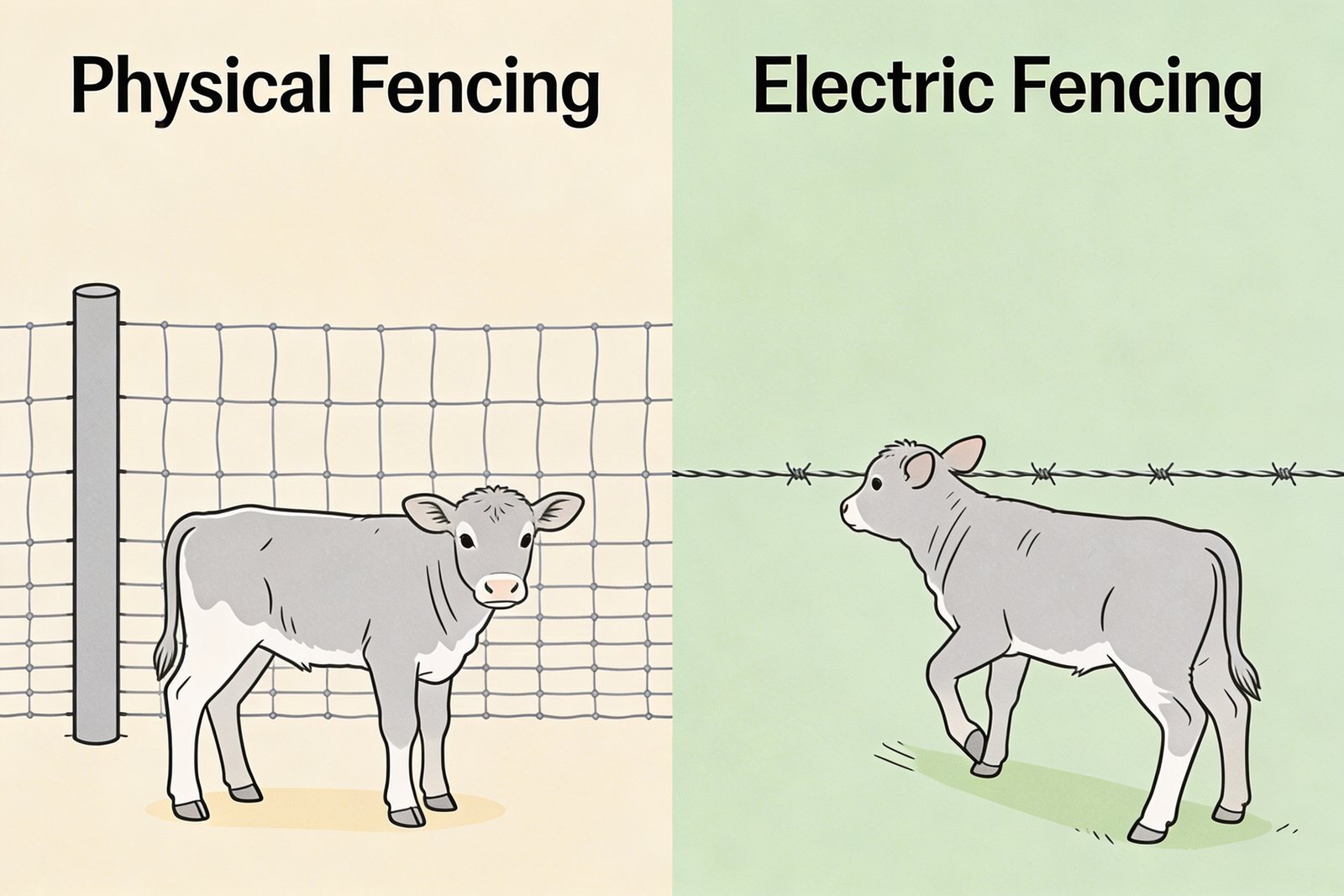
Electric Fence Height and Contact Reliability
Contact reliability is a major limitation when using electric fencing with young livestock. Wires set for adults are often too high to ensure consistent contact. Animals may walk under the wire, brush it with non-sensitive areas, or avoid it unintentionally.
Lowering wires improves contact but increases the risk of grounding issues and vegetation interference. These trade-offs are manageable with trained animals but problematic during early growth stages, when tolerance for inconsistency is low.
Because electric fencing effectiveness depends on repeatable contact at the right height and pressure, young livestock introduce too much variability for it to function reliably as a standalone solution.
When This Works Well
- Used in combination with a solid physical perimeter fence
- Introduced after animals have prior electric fence training
- Interior or rotational fencing with low escape consequences
- Situations with close monitoring and quick correction
When This Is Not Recommended
- Primary perimeter fencing for untrained young animals
- Areas with high predator pressure beyond the fence line
- Environments with heavy vegetation or poor grounding
- Situations where escapes carry immediate safety risks
Alternatives or Better Options
Woven wire fencing provides immediate physical containment without requiring training, making it more reliable during early life stages. It eliminates learning-based failure entirely.
Temporary panels or small-mesh fencing can work in confined areas such as pens or training zones, where animals can be introduced to electric fencing gradually.
Combination systems—physical fencing paired with an offset electric strand—offer a balance between safety and future flexibility, allowing electric fencing to become effective over time without carrying early-stage risk.
Cost, Safety, and Practical Notes
Electric fencing has a lower upfront material cost, but early failures can be expensive. Escaped young livestock are more vulnerable to injury, predation, and stress-related health issues. These costs often outweigh initial savings.
From a safety perspective, electric fencing itself is not inherently dangerous when properly energized, but repeated shocks during panic situations can increase stress and injury risk. Poorly grounded systems may also deliver inconsistent shocks, encouraging animals to challenge the fence.
Practically, electric fencing performs best when animals already understand boundaries. Using it too early shifts the burden from infrastructure to daily management, requiring frequent checks and adjustments. For long-term efficiency, it is often better introduced after a reliable physical system is already in place.
Quick Takeaway
Electric fencing can be safe for young livestock, but it works best as a supplement or later-stage tool—not as the sole barrier during early growth.