Short answer
Neither is “better” in every situation. Barbed wire is usually the stronger choice for a permanent perimeter fence where you need a physical barrier that works without power, while electric fence is usually better for interior divisions and flexible grazing because it trains cattle to avoid the boundary with minimal injury risk.
Why this question matters
The wrong fence choice can show up fast as escapes, repairs, or injuries. Cattle fencing also tends to become long-lived infrastructure, so small differences in reliability and maintenance needs can turn into big differences in total cost and workload over years.

Key factors to consider
- Class of cattle: mature cows typically respect either system once trained; bulls and newly weaned cattle test fences more; calves increase the downside of barbed wire injuries.
- Fence purpose: perimeter boundary versus interior subdivision; the consequences of a failure are much higher on a perimeter line.
- Management style: electric fence rewards frequent checking and quick fixes; barbed wire tolerates longer intervals between inspections.
- Terrain and vegetation: brushy fence lines can drain electric fences; rough terrain increases physical strain on any fence and can create low spots animals exploit.
- Power reliability: electric fencing depends on consistent energizer output and a strong ground system; outages or weak grounding reduce deterrence.
Detailed explanation
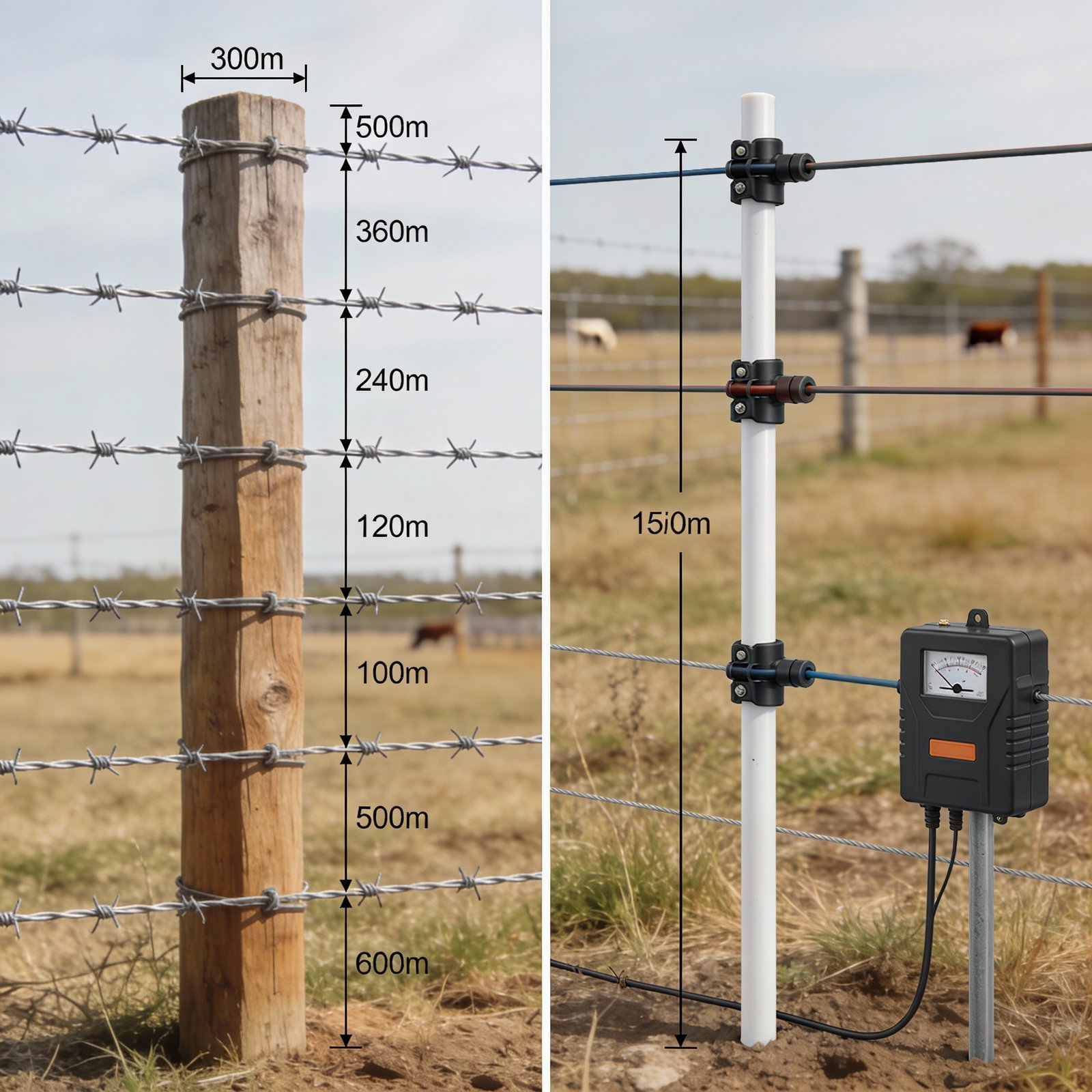
Barbed wire combines a physical barrier with discomfort from the barbs, so cattle learn not to lean, push, or reach through it. In typical cattle use it’s built as a multi-strand fence (often five or more strands) with closer post spacing, so it resists pressure even when animals crowd a fence line.
Electric fence works mainly through conditioning: a brief shock teaches cattle to keep space off the wire. After training, cattle often respect very light physical construction (one or two wires on wider post spacing), which is why electric fence is popular for interior moves and fast layout changes—if voltage stays consistently high enough for cattle to remember it.
Cost can overlap depending on how permanent and “heavy” the electric build is. As a broad installed range, barbed wire commonly runs about $3–$6 per linear foot, while electric fencing is often quoted around $1.50–$7 per linear foot installed, with the electric system’s total depending heavily on energizer/grounding choices and how much vegetation control is needed along the line.
Cost, safety, or practical notes
Barbed wire usually wins on “set it and forget it” perimeter reliability, but it carries real injury potential when animals panic, crowd, or hit loose/sagging strands. A fence safety survey reported that barbed wire (along with high-tensile and woven/welded wire) accounted for a large share of injuries, and a notable portion of injuries on these wire fences were serious enough to require veterinary attention, including deep lacerations and muscle tearing.
Electric fence generally reduces laceration/entanglement risk because cattle learn to avoid contact rather than rub or push on the wire. The trade-off is operational: if your fence is often underpowered from poor grounding, dead batteries, weed load, or outages, cattle may learn they can ignore it—especially higher-pressure animals like bulls or newly introduced stock.
Practical decision rule: for a perimeter, prioritize a physical barrier first (barbed wire, woven wire, smooth high-tensile), then add electricity as a “respect” tool if needed; for interior divisions, prioritize electric because it is faster to install and easier to reconfigure.
Quick takeaway
If you need a permanent, high-consequence boundary that still works when nobody has checked it today, barbed wire is often the better fit. If you need flexible control inside an already-secure perimeter—especially for paddock splits, temporary lanes, or frequent moves—electric fence is often the better fit, as long as you can keep it consistently hot and maintained.
Disclaimer: Fencing practices, safety requirements, and regulations may vary by location. Always check local laws and consult professionals when necessary.