Short Answer
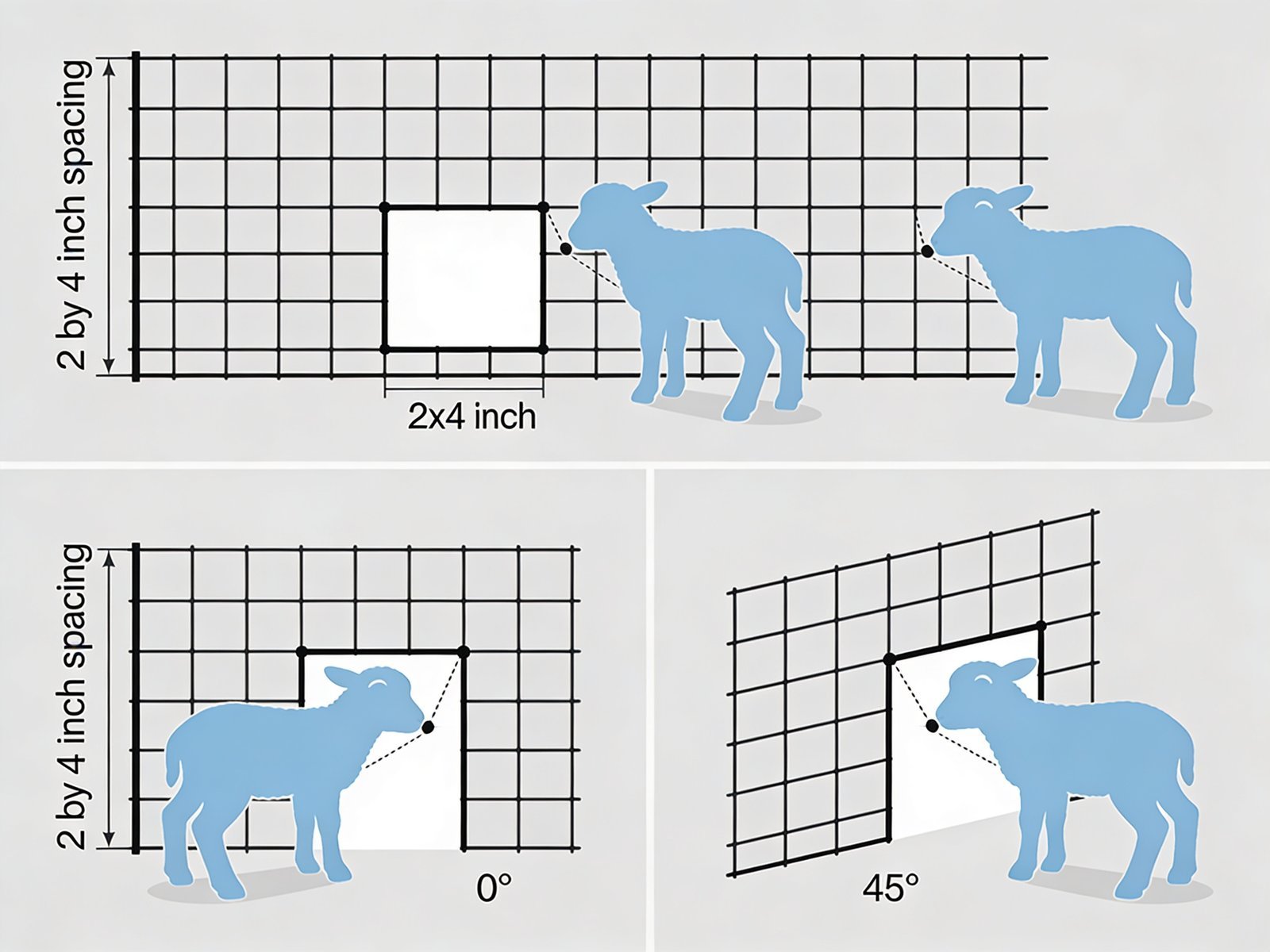
Fence spacing for baby animals should generally be no larger than 2 by 4 inches (5 by 10 cm). This size prevents young animals from pushing their heads or bodies through while still allowing visibility and airflow. Wider spacing significantly increases the risk of escapes and entanglement during early growth stages.
Why This Question Matters
Fence spacing is one of the most commonly underestimated factors in livestock containment, especially for young animals. Many producers select fencing based on strength or height, assuming spacing is a minor detail. In reality, spacing errors are a leading cause of early escapes and injuries. Baby animals are naturally curious, smaller than expected, and far more flexible than adults. A fence that appears secure can fail repeatedly without obvious damage. This question usually arises after animals slip through, get stuck, or attract predators by wandering outside protected areas—often turning a small design choice into a costly problem.
Key Factors to Consider
- Body width and head size of animals at their smallest growth stage
- Natural crawling, pushing, and exploratory behavior
- Fence deformation under repeated pressure
- Growth speed relative to fence lifespan
- Predator access through widened or stressed openings
Detailed Explanation
The recommended maximum spacing of 2 by 4 inches works because it aligns with the physical limits of most baby livestock during their most vulnerable stage. At this size, openings are small enough to block shoulders and hips, not just heads, which is critical because partial entry is what causes panic, injury, and fence damage.
Young animals do not evaluate risk the way mature livestock do. They push forward until resistance stops them, often committing their body weight before realizing they cannot pass through. Spacing that allows a head or leg to enter but not the body creates the highest injury risk. Uniform, small spacing removes these decision points entirely, reducing both escape attempts and entrapment.
Another important factor is fence deformation over time. Even properly sized spacing can become unsafe if the fence flexes excessively under pressure. When spacing starts small, minor stretching does not immediately create usable gaps. Wider initial spacing, however, becomes dangerous quickly once tension changes or animals repeatedly lean against the fence.
Spacing must also account for growth timing. Baby animals grow fast, but their most curious and vulnerable behavior occurs early. Designing spacing around adult size ignores the period when animals are most likely to test boundaries. By prioritizing the smallest body dimensions rather than average size, the fence remains effective throughout the transition to maturity without constant modification.
By the end of this stage, animals outgrow the risk—but if spacing is too wide early on, the damage is already done.
Behavioral and Physical Considerations
Baby Animal Behavior and Pressure Points
Baby animals explore fences differently than adults. They crawl under, press sideways, and test openings with their heads before committing their bodies. This behavior concentrates pressure on specific points—usually mid-panel areas, corners, and low sections near the ground.
Spacing that seems acceptable when viewed straight-on often fails at angles, where diagonal movement effectively increases the usable opening size. Once an animal successfully pushes partway through, repeated attempts follow, widening the gap over time.
Because of this, spacing must be evaluated under realistic movement, not static measurements. Smaller spacing reduces the chance that exploratory pressure turns into a learned escape behavior. It also limits fence fatigue by distributing force across more contact points instead of a single opening.
Species Size Variation at Early Growth Stages
While species differ, early growth stages share similar risks. Young goats, sheep, calves, and piglets are all narrow enough to exploit openings that are safe for adults. Differences in head shape and flexibility matter more than overall weight.
This is why spacing recommendations cluster around a narrow range rather than varying widely by species. Designing for the smallest likely body dimension creates a safety margin that holds across mixed groups or unexpected weight variation.
As animals mature, spacing becomes less critical, but fences are rarely replaced at that point. Choosing conservative spacing early prevents the need for temporary fixes, additional wiring, or interior barriers later on.
When This Works Well
- Containing baby animals during weaning or first pasture exposure
- Mixed-age groups where young animals follow adults closely
- Long-term perimeter fencing intended to last through maturity
- Areas with predator pressure exploiting small escape gaps
When This Is Not Recommended
- Short-term holding where animals are closely supervised
- Temporary fencing intended for frequent relocation
- Situations where visual openness is prioritized over containment
- Environments with extremely low stocking pressure
Alternatives or Better Options
Electric fencing can work with wider spacing once animals are trained, but it is unreliable during early stages without prior conditioning. It functions better as a secondary barrier rather than a primary solution for spacing issues.
Solid panels or boards eliminate spacing concerns entirely but reduce visibility and airflow. They are best suited for pens rather than large pasture runs.
Combination systems—small-spacing woven wire with an offset electric strand—can reduce pressure on the fence and discourage repeated contact, but only after proper spacing is already in place.
Cost, Safety, and Practical Notes
Smaller fence spacing increases material cost and installation time, but the trade-off is significantly lower risk. Repairing a single escape incident often exceeds the upfront savings of wider spacing.
From a safety perspective, uniform small spacing reduces entrapment injuries, which are more costly and harder to manage than simple escapes. The most common injuries occur not when fences break, but when animals become partially stuck.
Practically, spacing should be chosen once and built to last. Retrofitting spacing later is labor-intensive and rarely done consistently. Designing for the smallest animals at the start simplifies long-term management and reduces daily monitoring demands.
Quick Takeaway
If you want to prevent escapes and injuries during early growth stages, fence spacing should be small enough to block bodies—not just heads—before curiosity turns into habit.