Short Answer
Fencing for young or baby livestock typically costs $3 to $10 per linear foot for permanent fencing and $1 to $4 per linear foot for temporary systems. Total cost depends on materials, spacing, terrain, and whether predator protection is required. Designing for young animals usually costs more upfront but reduces long-term losses and repairs.
Why This Question Matters
Cost is often the final factor in fencing decisions—but for young livestock, it’s usually the most misunderstood one. Many producers budget based on adult fencing or choose the cheapest option to get started. The problem is that young animals expose weaknesses quickly, turning “low-cost” fencing into a cycle of repairs, escapes, and replacements. This question is often asked after expenses begin stacking up: extra labor, damaged fencing, lost animals, or predator incidents. Understanding real fencing costs upfront helps prevent paying twice—once for installation, and again for fixing what didn’t work.
Key Factors to Consider
- Fence type and material quality
- Mesh spacing and fence height requirements
- Terrain difficulty and post density
- Predator pressure and reinforcement needs
- Labor versus DIY installation
Detailed Explanation
Fencing costs for young livestock are driven less by animal size and more by error tolerance. Young animals require tighter spacing, better ground contact, and more consistent structure—all of which increase material and labor costs compared to adult fencing.
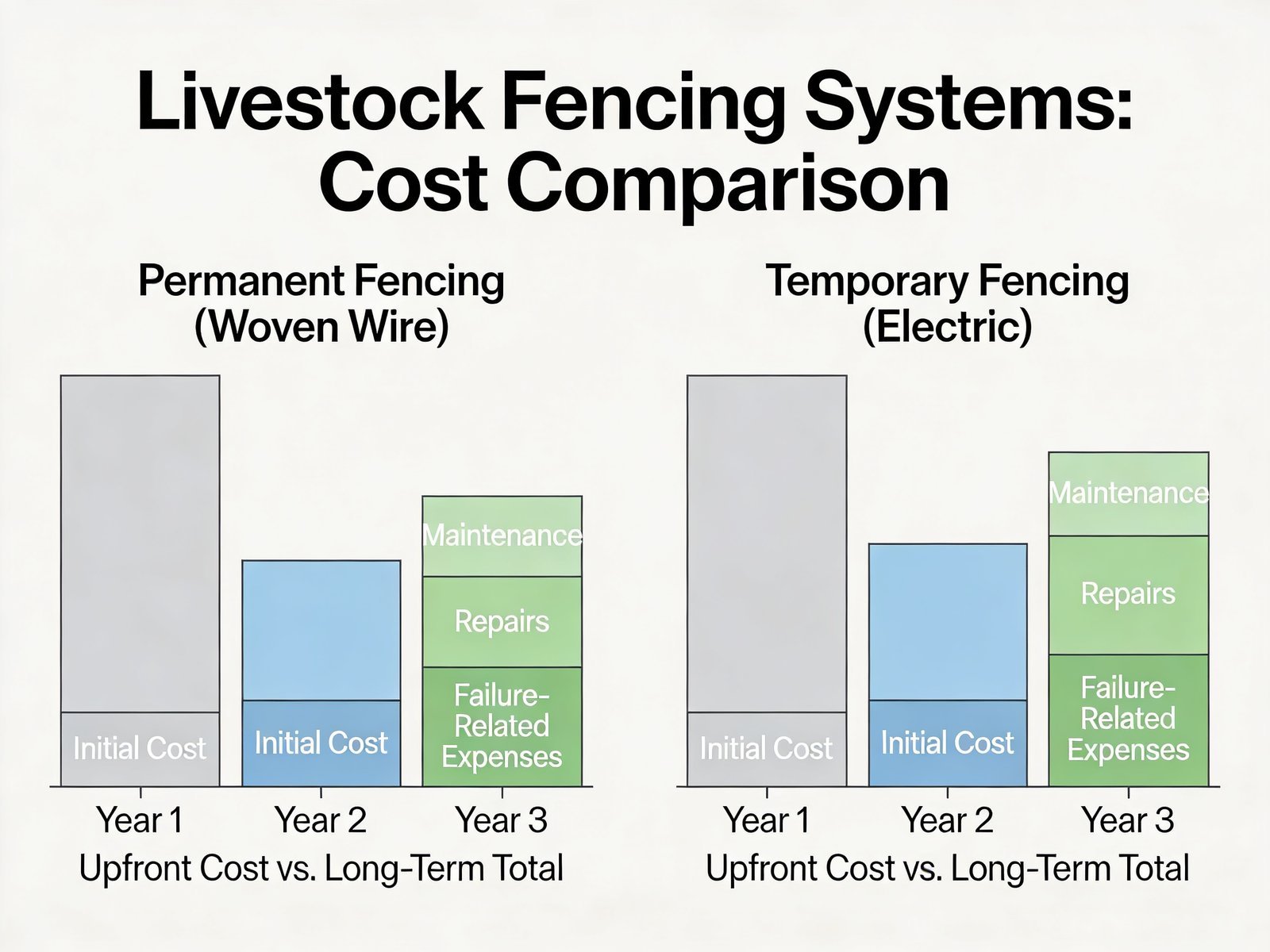
Permanent fencing such as woven wire typically falls in the mid-to-high cost range. The price reflects heavier materials, closer post spacing, and longer installation time. These systems cost more upfront but provide reliable containment without daily adjustment. For young livestock, this reliability often offsets the higher initial expense by reducing escapes, injuries, and predator access.
Temporary fencing systems are cheaper to install and faster to deploy, but their lower price reflects reduced durability and higher management demands. Costs increase over time through repairs, replacements, and labor. When used too early, temporary fencing often shifts cost from materials to daily supervision and problem-solving.
Terrain also plays a major role. Slopes, rocky soil, and uneven ground increase post requirements and installation time. Fencing that must be modified to maintain ground contact or height consistency quickly moves into a higher cost bracket.
Finally, predator protection adds another layer. Smaller mesh, reinforced bottoms, or offset electric strands raise upfront costs but dramatically reduce loss risk. For young livestock, fencing cost should be evaluated as a system expense—not just a material price—because early failures multiply downstream costs.
Cost Considerations and Trade-Offs
Permanent vs Temporary Cost Trade-Offs
Permanent fencing costs more initially because it is designed to absorb mistakes. It uses heavier posts, tighter spacing, and materials that tolerate repeated pressure. Once installed, ongoing costs are low.
Temporary fencing reduces initial expense but increases operational cost. Voltage checks, post realignment, vegetation control, and repairs become routine. For young livestock, these systems often fail before animals learn boundaries, which adds indirect costs like labor and stress.
The cost difference narrows over time. What looks cheaper in year one often becomes more expensive by year two when repeat issues are factored in.
Predator Protection and Cost Escalation
Predator pressure increases fencing costs quickly. Smaller mesh, reinforced corners, and ground-level security all add material and labor expense.
However, predator-related losses are disproportionately expensive with young livestock. One incident can exceed the cost of upgrading an entire fence line. This makes predator-resistant fencing one of the highest-return investments despite its higher upfront price.
Designing fencing to prevent first access is almost always cheaper than responding after predators learn entry points.
When This Works Well
- Budgeting for long-term fencing before animals arrive
- Permanent perimeter fencing for young livestock
- Areas with known predator pressure
- Operations aiming to reduce daily labor costs
When This Is Not Recommended
- Very short-term, supervised containment
- Training pens used briefly before relocation
- Interior fencing within already secure perimeters
- Situations where fencing will be replaced immediately
Alternatives or Better Options
Hybrid systems often offer the best cost balance. Permanent perimeter fencing combined with temporary interior fencing provides security while allowing flexibility.
Portable panels can work for confined spaces but become expensive at scale.
Phased installation—building permanent fencing first, then expanding gradually—helps manage budget while maintaining protection during early stages.
Cost, Safety, and Practical Notes
Fencing cost should be evaluated per failure avoided, not per foot installed. For young livestock, the most expensive fence is often the one that almost works.
From a safety perspective, consistent fencing reduces injury risk caused by partial failures. Injuries cost more than materials and create long-term animal stress.
Practically, it is easier to spend slightly more upfront than to retrofit spacing, height, or ground contact later. Designing once, correctly, keeps fencing costs predictable and prevents early-stage surprises.
Quick Takeaway
For young livestock, fencing costs are lowest when failures are prevented—not when materials are minimized.