Short Answer
High-tensile wire generally offers better value for money than welded wire fencing. While welded wire provides stronger physical containment, high-tensile wire delivers lower total costs over time due to reduced material usage, longer lifespan under tension, and simpler maintenance. For most large-scale or long-term fencing projects, high-tensile wire achieves a better cost-to-performance balance.
Why This Question Matters
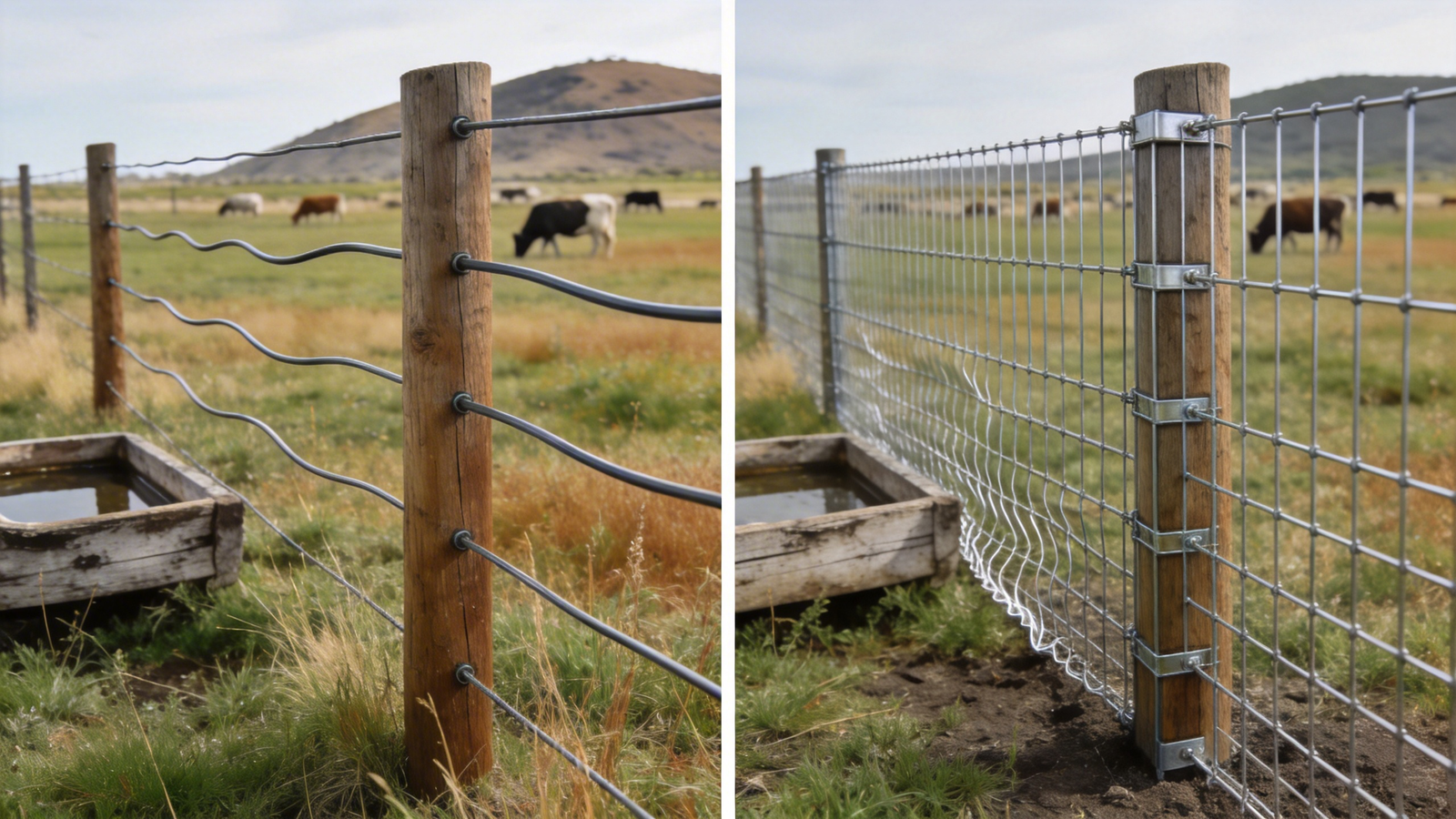
This is a real comparison landowners face when choosing fencing meant to last decades. Welded wire often appears more “solid” and secure, leading many to assume it delivers better value. High-tensile wire, by contrast, can look minimal and technical, which causes hesitation despite its widespread agricultural use. Choosing incorrectly can result in overspending on materials, unnecessary repairs, or fencing that fails under real livestock pressure. Because fencing costs scale with distance, even moderate price differences become significant over time. This question matters because value is not just about strength—it’s about performance per dollar over the fence’s usable life.
Key Factors to Consider
- Material cost per foot and required wire density
- Fence lifespan under constant tension and environmental exposure
- Repair complexity and frequency when damage occurs
- Suitability for long, continuous fence runs
Detailed Explanation
High-tensile wire fencing is designed to operate under sustained tension, allowing fewer strands and wider post spacing while maintaining effective containment. This efficiency dramatically lowers material requirements per linear foot. Installation requires proper tensioning, but once set correctly, high-tensile systems hold shape for years with minimal adjustment. The wire flexes under pressure and returns to position, reducing permanent deformation and breakage. High tensile wire has an average breaking strength of 1,500 pounds and a 3% elongation rate, compared to low carbon wire’s 13% elongation.
Welded wire fencing relies on rigid grid structures formed by welded intersections. While this provides immediate physical strength, it also creates stress concentration points. When pressure occurs—whether from livestock, wildlife, or falling debris—welds can break. A single failed weld often compromises a large section of fencing, reducing overall effectiveness and increasing repair complexity.
From a cost perspective, welded wire uses substantially more steel per foot than high-tensile wire. This raises upfront material costs and increases transportation and handling expenses. Repairs are also more labor-intensive, often requiring panel replacement rather than simple retensioning or strand repair. High tensile fencing products are stronger, lighter, longer lasting, and they cost less per foot for installation and cost less for maintenance over time.
Over long periods, high-tensile wire typically outlasts welded wire with fewer interventions. When maintenance is required, it is faster and cheaper. As a result, high-tensile wire delivers better value for money in most agricultural and perimeter fencing applications where scale, longevity, and efficiency matter. Because high-tensile wire only has 3% elongation compared to low-carbon wire’s 13% elongation, high-tensile wire doesn’t sag from snow load or when large livestock pushes up against it.
How Livestock Pressure Influences Value
Livestock behavior directly affects value outcomes. High-tensile wire performs best when animals apply steady, predictable pressure, allowing the wire to flex and recover. Welded wire resists pressure initially but degrades faster when animals push, lean, or panic. In high-pressure environments, welded wire’s rigidity often leads to earlier structural failure, reducing its long-term value despite higher upfront strength. A good high tensile fence will spring back to form even when under pressure.
Fence Length and Layout Considerations
Value differences become more pronounced as fence length increases. High-tensile wire scales efficiently across long, straight runs with fewer posts and anchors. Welded wire becomes disproportionately expensive in large layouts due to material weight, installation time, and repair difficulty. In expansive fencing projects, high-tensile systems consistently deliver better cost efficiency. High tensile products in most cases come close to doubling the breaking strength of low-carbon products, and the coatings last longer.
When This Works Well
- Large pasture or perimeter fencing projects
- Long, straight fence runs with limited corner complexity
- Operations prioritizing low maintenance over decades
- Livestock accustomed to wire fencing boundaries
When This Is Not Recommended
- Small enclosures requiring maximum physical containment
- Situations involving young or small livestock prone to entanglement
- Areas with frequent impact from wildlife or falling debris
- Projects lacking proper installation expertise
Alternatives or Better Options
Electric high-tensile fencing adds behavioral control while preserving material efficiency and long-term value. Woven wire fencing offers better containment for mixed or small livestock but increases total cost. Hybrid systems combine high-tensile wire for perimeters with welded or woven wire in high-risk zones. Fixed knot woven wire is very secure and is very hard for livestock to scoot back and forth, providing superior holding strength.
Cost, Safety, and Practical Notes
High-tensile wire delivers superior value only when installed correctly. Improper tensioning reduces lifespan and safety. Welded wire is easier to understand visually but often fails earlier under real-world stress. From a safety standpoint, high-tensile smooth wire reduces injury risk compared to broken welded panels. In practical use, value comes from durability per dollar, not maximum rigidity at installation.
When working with high tensile wire, installers usually don’t have to stretch the wire by much for the fence to maintain stability, making high tensile wire products a preferable choice for clients looking for a more durable fence. Low carbon wire stretches significantly under load due to its high elongation factor, meaning it won’t return to its original shape, while high tensile wire holds strong, resisting stretching and maintaining its integrity even after heavy pulls.
Video Demonstration
Quick Takeaway
High-tensile wire provides better value for money than welded wire in most long-term fencing scenarios. Its lower material cost, durability under tension, and simpler maintenance outweigh the short-term strength advantages of welded wire.