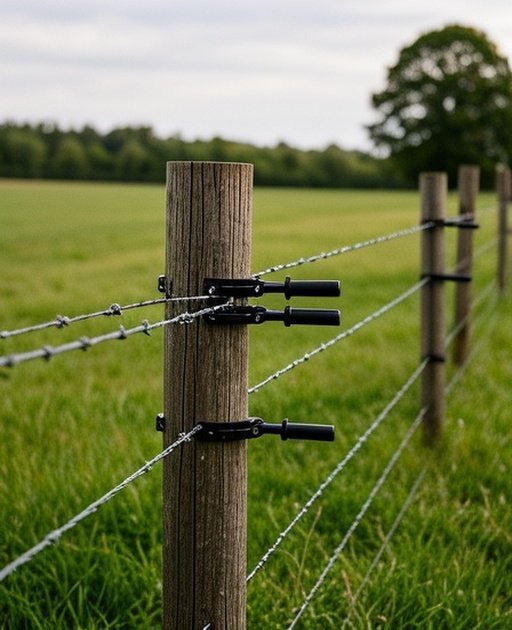
High tensile wire fencing is a durable, low-maintenance fencing system commonly used for large livestock pastures and perimeter boundaries. Unlike traditional barbed wire, high tensile systems rely on strong, tightly tensioned smooth wire that resists stretching and sagging over long distances.
YouTube search query: “how to install high tensile wire fence step by step tutorial”
What This Guide Covers
What Is High-Tensile Wire Fencing?
High-tensile wire is a smooth, hard-drawn steel wire typically manufactured in 12.5 or 14 gauge, with tensile strength of 170,000–200,000 PSI — roughly 3–4 times stronger than standard mild steel wire used in conventional fencing. This high strength allows the wire to be strung at greater tension without permanent deformation, which means fewer posts are needed (30-foot spacing versus 12–16 feet for conventional wire) and the fence maintains its tautness without constant re-tensioning.
High-tensile wire is used both as a permanent fence (multiple smooth wire strands with in-line strainers) and as electric fencing (same wire energized with a charger). The permanent smooth-wire configuration contains cattle reliably when properly built; the electric configuration uses psychological deterrence to reduce fence contact and extends the life of the wire. Many operations combine both — physical high-tensile fence for perimeters with electric offset strands inside.
How Many Strands for Cattle vs Other Livestock?
For beef cattle, a 5-strand high-tensile fence with strands at 10, 20, 30, 42, and 54 inches provides secure containment on most operations. Three-strand configurations at 16, 32, and 48 inches work for mature cattle in low-pressure situations but are inadequate for bulls, calves, or animals unfamiliar with the fence. Adding electric to any strand configuration dramatically reduces fence-testing behavior.
For horses, smooth high-tensile wire requires extra visibility measures — the wire is difficult for horses to see at speed, creating collision risk. Add high-visibility tape or flags to the top wire, or substitute poly tape for at least the top strand. For goats and sheep, high-tensile smooth wire alone is inadequate; those animals find and exploit any gap. Use high-tensile wire as the framework for woven wire or add bottom strands tight to the ground.
What Are In-Line Strainers and Why Do They Matter?
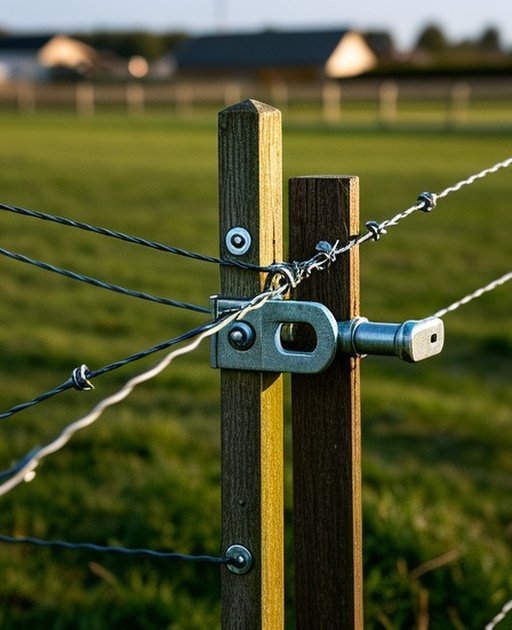
In-line strainers (also called inline tensioners or wire ratchets) are mechanical devices spliced into each wire strand every 1/4 to 1/3 mile that allow wire tension to be maintained and adjusted without cutting the wire or accessing end posts. They're the key maintenance advantage of high-tensile wire over conventional fencing — annual tension checks and adjustment with a strainer wrench take minutes per strand versus the labor-intensive process of re-stapling and re-stretching conventional wire.
Properly installed in-line strainers maintain consistent tension across long fence runs as posts shift seasonally, wire temperature-expands and contracts, and terrain settles. Each strainer holds roughly 4 inches of adjustment capacity — adequate for several years of seasonal tension changes before requiring replacement. The investment in quality in-line strainers (versus the cheap imported versions) pays back quickly in fence longevity.
Installing High-Tensile Wire on Sloped Terrain
High-tensile wire on sloped or hilly terrain requires careful planning to maintain consistent tension without creating unacceptable gaps under the fence on downhill slopes. The key principle is that high-tensile wire follows a straight line between anchor points — it won't conform to terrain contours without intermediate ground anchors. On significant slopes (more than 15% grade), install vertical droppers or ground anchors at the lowest terrain points to hold wire close to the ground.
For very steep terrain, conventional woven wire often installs better than high-tensile because woven wire can be conformed to terrain contours with appropriate post placement. High-tensile shines on relatively flat to gently rolling terrain where long spans between anchor posts are feasible. Many producers use high-tensile for flat sections and transition to woven wire or board rail for steep slopes and areas requiring tight ground contact.
High-Tensile Fence Longevity and Maintenance
Properly installed high-tensile wire fence has an expected lifespan of 20–30 years for the wire itself. The primary maintenance requirements are annual tension checks using in-line strainers, re-stapling any loose wire at wooden posts (T-posts use clips that don't require staples), and checking corner and end braces for settlement or damage. Insulators on electric strands require inspection for cracking or UV degradation every 3–5 years.
Compare this maintenance profile to conventional barbed wire, which typically requires re-tensioning and re-stapling every 5–7 years due to wire stretch and post movement. High-tensile wire's resistance to permanent deformation means it springs back to proper tension after livestock pressure rather than staying stretched. Over a 25-year fence life, high-tensile requires 60–70% less maintenance labor than conventional wire fencing.
What Is High Tensile Wire Fencing?
High tensile wire fencing uses high-strength steel wire designed to be stretched to much higher tension levels than conventional low-carbon wire.
High-tensile wire is the most cost-effective choice for large acreage fencing over 50 acres. The reduced post requirement (30-foot spacing versus 12–16 feet for barbed wire) cuts material and installation costs significantly. A mile of 5-strand high-tensile with posts at 30 feet uses 176 posts versus 330 posts for barbed wire — saving $1,500–$3,000 in materials alone per mile. Plus the 30-year wire lifespan reduces replacement cost compared to 15–20 year barbed wire.
For very large operations (500+ acres), the post and wire savings from high-tensile often justify the cost of a professional fence installation crew with specialized high-tensile equipment. The investment in a permanent, low-maintenance perimeter fence with properly installed in-line strainers returns value across decades of operation.
If You Want Minimal Maintenance
High-tensile electric fence with quality in-line strainers and a properly sized low-impedance energizer is the lowest ongoing maintenance perimeter fence for cattle operations. Annual checklist: test voltage at the far end of the fence (minimum 3,000 volts), tighten in-line strainers if needed, check ground rods for corrosion, clear vegetation touching the fence. This process takes 2–4 hours per mile versus a full day for equivalent barbed wire maintenance.
The ground system is the most overlooked maintenance item. Three ground rods minimum (6 feet each) spaced 10 feet apart in moist soil provide adequate grounding for most systems. In dry or sandy soil, 6–8 ground rods are necessary. Poor grounding causes low fence voltage that allows livestock to pass through — always diagnose grounding before blaming the energizer.
If You Need Large Pasture Perimeter Fencing
High tensile wire excels for large cattle pastures and perimeter fencing where long wire spans between widely-spaced pos
High tensile fencing typically ranges from 42–54 inches in total height for cattle, with 4–5 strands providing adequate containment. Smaller livestock like sheep and goats may require 8–10 strands reaching heights of 40–48 inches with tighter spacing, particularly near ground level.
Strand spacing is closer at the bottom—typically 8–10 inches for the lowest wire above ground—then gradually increases toward the top. This configuration prevents animals from crawling under while maintaining material economy. Proper tension prevents sagging between widely-spaced posts and improves fence longevity.
Safety Factors
Smooth high tensile wire is safer than barbed wire because it lacks sharp barbs that cause lacerations, butit can still cause injury if poorly tensioned or if animals run into tight wires at speed. Properly tensioned wire maintains consistent height and visibility, reducing collision risk.
Electric high tensile systems rely on psychological deterrence rather than physical containment alone—animals learn to respect the fence through mild shocks rather than testing it physically. Proper grounding and voltage maintenance are essential for safety and effectiveness.
Cost & Maintenance
High tensile fencing usually costs more upfront than barbed wire—typically 20–40% higher per linear foot—but requires significantly fewer repairs over its service life. The superior tensile strength maintains tension longer, reducingsagging and the need for re-tightening.
Long-term maintenance mainly involves periodic tension checks (annually or after severe weather), vegetation control for electrified systems, and replacing damaged strands or insulators. Galvanized wire resists rust for 25+ years in most climates. For lifecycle cost analysis, see the Fence Cost & Budgeting guide.
Installation Complexity
Proper high tensile installation requires robust corner braces, in-line strainers, specialized tensioning tools, and accurate post spacing. The installation process is more technical than traditional fencing because tension management is critical to system performance.
Poor bracing is the most common cause of failure—corner and brace assemblies must be overbuilt to handle tremendous tension loads. Many installers underestimate bracing requirements, leading to leaning posts and tension loss. For installation guidance and bracing designs, see the Fence Planning Basics guide.
Legal & Boundary Considerations
Local fence regulations may restrict electric fence use near residential areas, public roads, or recreational trails due to safety concerns. Some jurisdictions require specific signage for electrified fencing or mandate minimum setback distances.
Height restrictions and property line requirements vary by location. Shared boundary fences may require neighbor agreement on design and tension loads that affect adjoining property. For legal planning and compliance guidance, see the Local Fence Laws & Regulations guide.
Yes, high tensile wire has significantly higher tensile strength (170,000–200,000 PSI) compared to traditional low-carbon barbed wire, allowing it to resist stretching and maintain tension better over long distances and temperature changes.
How long does high tensile fencing last?
With proper installation, quality galvanized coating, and adequate maintenance, high tensile fencing can last 25–40 years or more—significantly longer than barbed wire systems.
How many strands are needed for cattle?
Typically 4–5 strands provide adequate containment for mature cattle, while 5–7 strands work better for mixed herds including calves or in high-pressure situations.
Can high tensile wire stop predators?
When electrified, high tensile systems can deter many predators through psychological conditioning, but they may require reinforcement with woven wire in areas with persistent predator pressure.
Is high tensile fencing expensive?
Upfront cost may be 20–40% higher than barbed wire, but reduced post requirements, longer lifespan, and lower maintenance needs often make it more economical over time.
Final Recommendations
High tensile wire fencing is ideal for large pastures, perimeter fencing, and low-maintenance livestock containment systems where long wire spans and reduced post counts provide significant economic advantages. It offers exceptional long-term durability and cost efficiency when properly installed with robust corner bracing and correct tensioning.
Choose high tensile fencing if you prioritize strength, longevity, and reduced repair frequency over minimal initial cost. For tighter physical containment of small livestock or superior predator resistance, woven wire may be more suitable. For flexible rotational grazing systems with behavioral training, consider electrified high tensile or dedicated electric fencing options.
Short Answer High-tensile wire generally offers better value for money than welded wire fencing. While welded wire provides stronger physical containment, high-tensile wire delivers lower…
Yes, high-tensile wire is strong enough for livestock fencing when it is properly designed, tensioned, and supported. Its strength comes from high-carbon steel and constant…
High-tensile wire fencing typically lasts 25–40 years outdoors, and often longer under favorable conditions. Its lifespan depends on wire coating quality, installation accuracy, livestock pressure,…
Explore More Fencing Guides
Find the right fence for your farm — browse by livestock type, material, or project need.