Short Answer
A perimeter fence for livestock should generally be 48–54 inches for cattle, 54–60 inches for horses, 42–48 inches for goats, and 36–42 inches for sheep. Perimeter fencing should always lean toward the higher end of each range because it serves as the primary containment and security boundary.
Why This Question Matters
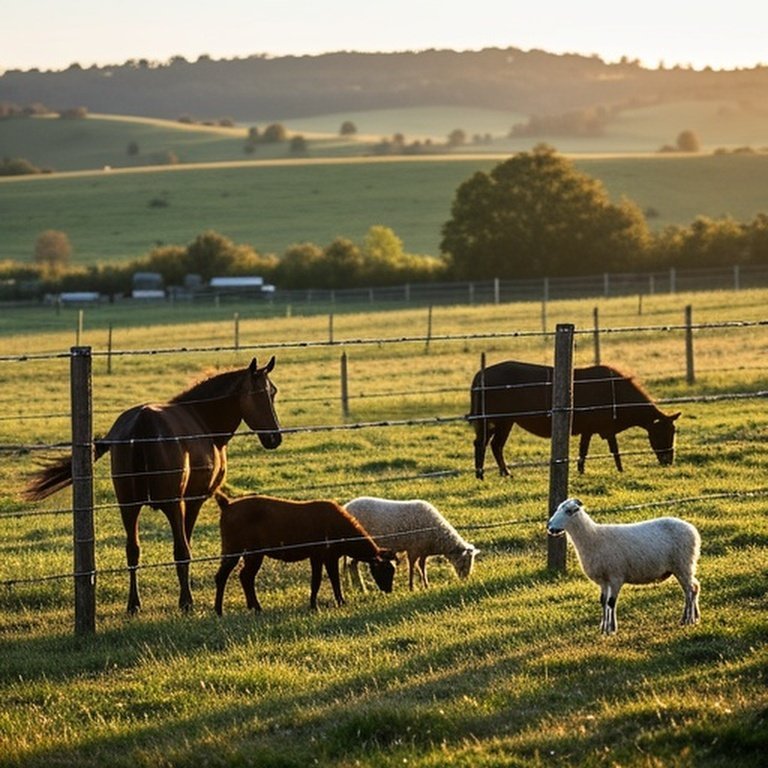
Perimeter fencing is fundamentally different from interior cross fencing. It is the final barrier between livestock and roads, neighboring properties, predators, and liability risk. If animals escape an interior paddock, the perimeter fence still protects them. If the perimeter fails, consequences can involve injury, traffic accidents, legal exposure, or loss of valuable breeding stock.
Height directly influences containment reliability. A fence that is technically sufficient for interior rotational grazing may be inadequate at the boundary line where animals experience external pressure. Wildlife interaction, breeding behavior, and feed-driven motivation all increase stress at perimeter lines. Choosing the correct height reduces escape attempts and long-term repair costs.
Key Factors to Consider
- Species-specific behavior and jumping or climbing tendencies
- Predator presence and wildlife pressure in your region
- Proximity to roads, neighbors, or public access
- Terrain slope and erosion potential along fence lines
- Whether mixed livestock share the same boundary
Detailed Explanation
Perimeter fencing must be designed for worst-case behavior, not everyday calm grazing. Cattle typically require 48–54 inches, but if bulls or high-energy breeds are present, 54 inches provides additional deterrence against leaning and pushing. Cattle rarely jump high barriers, yet they will challenge weak or sagging fences under feed or breeding pressure.
Horses demand taller perimeter fencing than interior fencing because their flight instinct can be triggered by noise, wildlife, or unfamiliar movement. A 54–60 inch fence reduces the likelihood of jumping attempts while maintaining visibility. Height alone is insufficient—rail spacing and structural strength must support the vertical dimension to prevent hoof entrapment or breakage.
Goats and sheep require different considerations. Sheep rarely jump high fences, but they exploit low gaps. Goats, however, will test vertical limits by climbing or rearing. A 42–48 inch perimeter fence with tight spacing and proper tensioning reduces scaling behavior. In high-predator areas, slightly increasing height or adding deterrent measures improves security.
Perimeter fencing should always be more robust than interior fencing because it experiences greater environmental and behavioral pressure. Wind, fallen branches, wildlife crossings, and seasonal soil shifts all weaken fence structure over time. Designing with a height buffer reduces failure risk and protects long-term investment.
Extended Practical Considerations
How Animal Behavior Affects This Choice
Animal behavior intensifies at boundary lines. Livestock are more likely to test perimeter fences due to external stimuli such as neighboring animals, wildlife, traffic noise, or feed visibility beyond the boundary. Horses may attempt to clear fences when startled. Cattle push collectively when feed or breeding pressure rises. Goats test vertical strength out of curiosity rather than panic.
A perimeter fence must therefore exceed the minimum height required for simple containment. Designing only for average behavior ignores stress-driven reactions. Height combined with structural reinforcement reduces the likelihood that animals learn they can challenge the boundary successfully.
Young vs Mature Livestock Considerations
Young animals typically do not challenge height as aggressively as mature breeding stock, but they are more likely to slip through lower spacing gaps. If calves or lambs are present, lower wire spacing becomes critical even if total height remains unchanged.
Mature bulls, stallions, and dominant males exert significantly more pressure on boundary fences. For operations managing breeding animals, selecting the upper end of recommended height ranges is a safer long-term decision.
Terrain, Visibility, and Pressure Zones
Sloped terrain effectively reduces fence height on the downhill side. Erosion can also create gaps beneath fencing. In these cases, adding extra vertical margin helps maintain containment standards.
Corners, gates, and shared fence lines with neighbors experience concentrated pressure. These zones benefit from slightly increased height or reinforced construction to maintain structural integrity over time.
When This Works Well
- Single-species operations with predictable herd behavior
- Moderate predator exposure and low wildlife pressure
- Clearly defined property lines with minimal public access
- Flat terrain with stable soil conditions
- Properly tensioned and braced fence systems
When This Is Not Recommended
- Mixed livestock requiring significantly different containment heights
- High predator regions without additional deterrent systems
- Extremely uneven terrain prone to erosion
- Breeding facilities with aggressive or high-value animals
- Boundary lines exposed to heavy wildlife crossings
Alternatives or Better Options
Electric Offset Wire Addition
Installing a single electric offset wire inside the perimeter fence discourages leaning, climbing, and pushing. This approach can enhance containment without significantly increasing overall fence height.
Woven Wire with Reinforced Top Rail
Combining woven wire mesh with a visible and sturdy top rail improves both containment and psychological deterrence, especially for horses and goats.
Double Perimeter Systems
In high-risk areas, installing a secondary interior barrier creates redundancy. This system is more effective for security than simply increasing fence height alone.
Cost / Safety / Practical Notes
Increasing perimeter fence height raises material costs, post length requirements, and labor intensity. Taller posts require deeper setting for stability, especially in soft or sandy soils. However, undersizing perimeter fencing often leads to recurring maintenance and potential legal liability if animals escape.
Safety must remain central. Barbed wire is generally unsuitable for horses, regardless of height. High-tensile systems require proper tensioning to maintain functional height over time. Sagging wires effectively reduce containment height and compromise security.
The trade-off is straightforward: slightly higher upfront investment versus long-term risk mitigation. In most perimeter applications, selecting the upper end of recommended height ranges provides better operational stability and lower lifetime maintenance.
Quick Takeaway
Perimeter fences should be taller and stronger than interior fencing. For most livestock, choose the upper end of recommended ranges—54 inches for cattle, 60 inches for horses, 48 inches for goats, and 42 inches for sheep. Design for peak pressure, not average behavior.