PVC fencing is generally safer for animals than barbed wire and rough wood, but less forgiving than flexible wire systems. Its smooth surfaces reduce cuts and scrapes, yet its rigid structure can fail suddenly under pressure. Safety depends on livestock type, pressure level, climate, and whether PVC is used as a primary barrier or a visual boundary.
Why This Question Matters
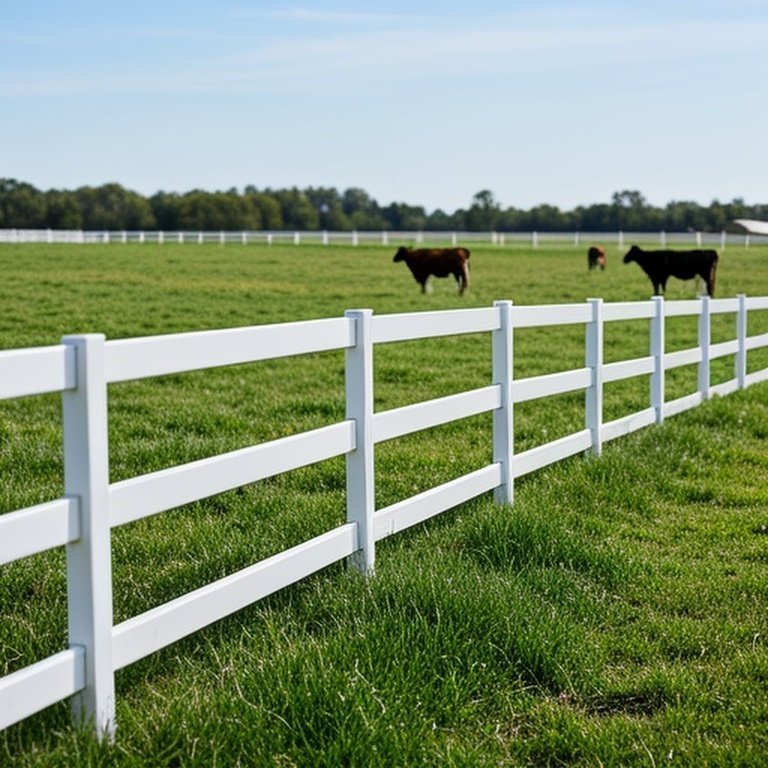
Animal safety is often the deciding factor in fencing choices, especially for horses, young stock, or mixed herds. PVC fencing is frequently promoted as “safe” because it has no sharp edges or exposed metal. However, safety is not only about surface contact—it also involves how a fence behaves when animals push, panic, or crowd.
A fence that looks safe but fails suddenly can create greater risk than one that flexes or deforms gradually. This question matters because misunderstanding PVC’s safety profile can lead to injuries, escapes, or false confidence in high-pressure livestock environments.
Key Factors to Consider
- Surface contact: smooth rails reduce cuts compared to barbed wire
- Failure behavior: rigid materials break rather than deform
- Livestock size and behavior: pressure determines real-world safety
- Climate effects: cold increases brittleness and break risk
- Fence role: primary containment versus visual or secondary barrier
Detailed Explanation
From a surface-safety perspective, PVC fencing performs well. Unlike barbed wire, it has no sharp points that tear hide or cause deep lacerations. Compared to wood, it eliminates splinters, protruding nails, and rough edges that can injure animals during rubbing or impact. For animals that make light, occasional contact, this smoothness is a clear advantage.
However, safety must also consider what happens under stress. PVC is rigid and has limited ability to absorb force. When animals lean, crowd, or panic, PVC resists movement until it reaches a failure point, then breaks abruptly. This contrasts with wire fencing, which redistributes force, or wood fencing, which often cracks or bends gradually—both providing warning and partial containment during failure.
In practical farm conditions, most serious safety incidents occur during moments of pressure: herd movement, feeding competition, or sudden fright. In these scenarios, a fence that fails suddenly can create sharp edges, loose rails, or escape openings. While these risks are manageable with proper placement and reinforcement, they mean PVC is not universally safer than wire or wood.
Climate further affects safety. In cold weather, PVC becomes more brittle, increasing the chance of cracking from impact. In hot weather, increased flexibility can lead to joint stress and pull-out. Neither condition is inherently unsafe, but both reduce the margin for error when animals apply force.
In summary, PVC fencing is safest when animal contact is minimal and predictable. Its safety advantage lies in surface smoothness, not in structural forgiveness.
How Cattle Behavior Affects This Choice
Cattle safety is closely tied to behavior. Calm, pasture-trained cattle may rarely touch a fence, making PVC relatively safe in those settings. Problems arise when cattle crowd boundaries, rub frequently, or test fences near feed and water. PVC’s rigidity encourages a binary outcome: it holds, or it breaks.
Once cattle learn a fence flexes, repeated pressure increases. This can lead to sudden failures that create escape points or sharp break edges. Electrification or behavior management greatly improves safety by reducing physical contact. Without these controls, PVC fencing is more vulnerable to behavior-driven safety risks than flexible wire systems.
Calves vs Mature Cattle Considerations
Calves are lighter and less forceful, making PVC fencing comparatively safe for short-term or controlled enclosures. Visibility helps prevent accidental collisions, which further reduces injury risk.
Mature cattle present a different profile. Adult weight and herd pressure can exceed PVC’s structural tolerance. When failures occur, they tend to be abrupt, increasing the chance of containment loss. For mature cattle, PVC is safer as a secondary or visual fence rather than primary containment.
Terrain, Visibility, and Pressure Zones
PVC fencing is safest on flat terrain where rails remain evenly loaded. Uneven ground introduces stress points that increase break risk.
Visibility is a strong safety advantage—animals see PVC clearly and avoid accidental contact. However, pressure zones such as gates, corners, and feeding areas override this benefit. These locations require reinforcement or alternative materials to maintain safety.
When This Works Well
- Horses or animals sensitive to sharp edges
- Low-pressure livestock environments
- Flat terrain with stable soil
- Visual boundaries or secondary fencing
- Areas with controlled animal movement
When This Is Not Recommended
- Primary containment for mature cattle
- High-pressure feeding or watering areas
- Cold climates with impact risk
- Uneven or sloped terrain
- Situations with frequent herd crowding
Alternatives or Better Options
Smooth wire or high-tensile electric fencing offers flexibility with fewer sharp edges.
Wood fencing provides visual safety and gradual failure but needs maintenance.
Hybrid systems using PVC for visibility and wire or electric fencing for strength often deliver the best balance of safety and containment.
Cost, Safety, and Practical Notes
PVC fencing reduces injury risk from cuts and abrasions but introduces different safety considerations related to sudden failure. Repairs often involve replacing entire sections, which can temporarily compromise containment.
From a practical safety standpoint, PVC works best when animals are discouraged from physical contact. Its safest use is deliberate placement in low-pressure roles, not as a universal replacement for wire or wood.
Quick Takeaway
PVC fencing is safer than barbed wire for surface contact but less forgiving than flexible wire systems—its real safety depends on livestock pressure, climate, and how the fence is used.