Short Answer
The best fencing for lambs is tightly spaced woven wire that prevents slipping through or crawling under. For adult sheep, standard woven wire fencing is usually sufficient. Lambs require smaller openings and stricter ground control, while adult sheep mainly need reliable physical containment rather than finer spacing.
Why This Question Matters
Many fencing failures happen when producers assume that fencing suitable for adult sheep will also work for lambs. Lambs are smaller, more agile, and far more likely to exploit gaps, loose wire, or ground openings. When fencing does not account for age differences, lamb escapes, injuries, and predator losses increase quickly. This question matters because flocks often contain mixed age groups, and a fence that works “most of the time” for adults may fail completely once lambs are introduced. Choosing fencing without considering age-specific behavior leads to avoidable losses and costly retrofits.
Key Factors to Consider
- Lamb size allows passage through gaps that stop adult sheep.
- Ground contact quality affects lamb escape more than adult containment.
- Fence opening size determines whether lambs slip through or become trapped.
- Predator risk increases sharply when lambs escape fencing.
Detailed Explanation
Lambs and adult sheep interact with fencing very differently, which is why a single “one-size-fits-all” recommendation often fails. Adult sheep are primarily stopped by height and overall barrier strength. Once trained, they respect physical fences and apply less pressure to wire spacing. Standard woven wire fencing typically provides enough containment for adults as long as tension and ground contact are maintained.
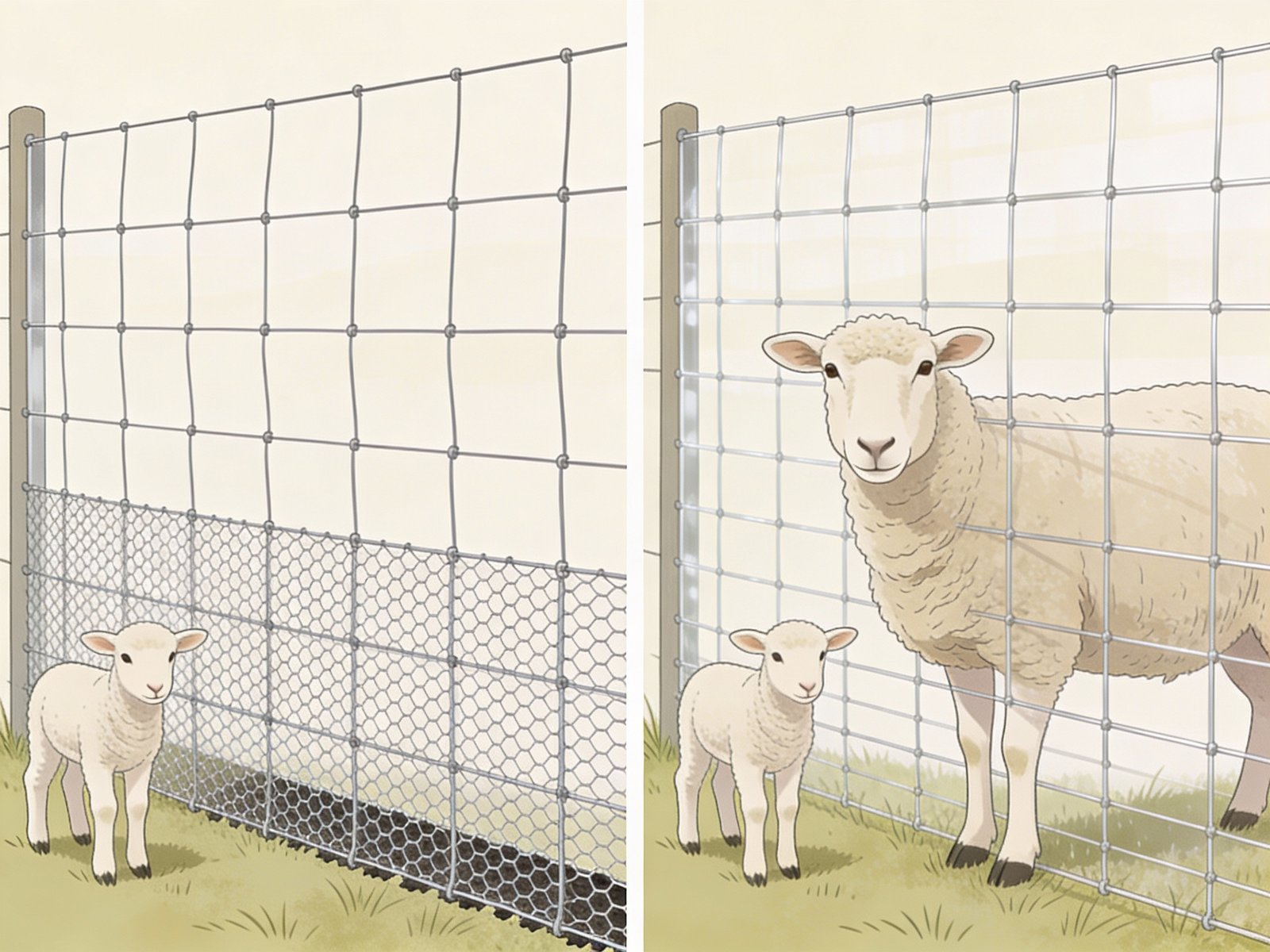
Lambs, however, introduce a different risk profile. Their smaller bodies allow them to push through wider wire openings, especially near the bottom of the fence. Lambs also crawl under fences more readily, exploiting minor ground gaps that adults ignore. This makes bottom wire spacing and fence-to-ground contact far more critical for lamb containment than for adult sheep.
Another key difference is failure consequence. When adult sheep test a fence, escapes often happen slowly and are noticed quickly. Lamb escapes can occur suddenly and in groups, increasing exposure to predators and environmental hazards. Once lambs learn a fence is passable, repeated escapes are likely unless the fence is rebuilt or reinforced.
Because of these behavioral and physical differences, fencing that works perfectly for adult sheep may still be inadequate for lambs. Effective sheep fencing must be designed to the most vulnerable animal in the flock, which is almost always the lamb.
Understanding Fence Requirements
Fence Opening Size and Bottom Spacing
The single most important difference between lamb and adult sheep fencing is opening size, especially near ground level. Lambs can pass through openings that appear impossibly small to adult sheep. Even fences that meet general sheep standards may fail if bottom wire spacing is too wide or if the fence lifts slightly above ground. Tight bottom spacing and consistent ground contact dramatically reduce lamb escapes without affecting adult sheep movement.
Mixed Flocks and Seasonal Changes
Fence requirements often change seasonally as lambs are born and grow. A fence that works during non-lambing periods may fail immediately once lambs are introduced. Mixed-age flocks create a challenge because fencing must meet lamb-level standards year-round, even when lambs are not present. Designing for lambs from the start avoids seasonal rework and emergency fixes.
Predator Pressure Amplifies Lamb Risk
Lamb escapes are far more dangerous than adult escapes. Lambs lack predator awareness and stamina, making even short fence breaches costly. In predator-prone areas, fencing that merely contains adult sheep is insufficient. Lamb-focused containment becomes a critical part of overall flock protection, not just a convenience feature.
When This Works Well
- Permanent fencing designed to lamb standards from the beginning.
- Operations with mixed-age flocks present most of the year.
- Areas with moderate to high predator pressure.
- Producers prioritizing loss prevention over minimal material cost.
When This Is Not Recommended
- Adult-only flocks with no lambing on pasture.
- Temporary fencing used for short-duration grazing.
- Highly supervised systems with constant human presence.
- Situations where lambs are fully confined indoors.
Alternatives or Better Options
Woven wire with smaller bottom openings improves lamb containment without changing fence height or overall structure. Electric offset wires near ground level discourage crawling and nose-testing by lambs when combined with physical fencing. Temporary lambing paddocks allow stricter fencing only where lambs are present, reducing total material cost.
Cost, Safety, and Practical Notes
Fencing built to lamb standards costs more upfront due to tighter wire spacing and stricter installation requirements. However, these costs are usually lower than losses from escaped or predated lambs. Safety considerations include preventing lambs from becoming trapped in improperly sized openings. From a practical standpoint, most producers regret underbuilding fences for lambs but rarely regret building stronger fences than adults strictly require. Designing for the weakest animal in the system is usually the most cost-effective long-term choice.
Quick Takeaway
If a fence works for lambs, it will work for adult sheep. The reverse is often not true.