Short Answer
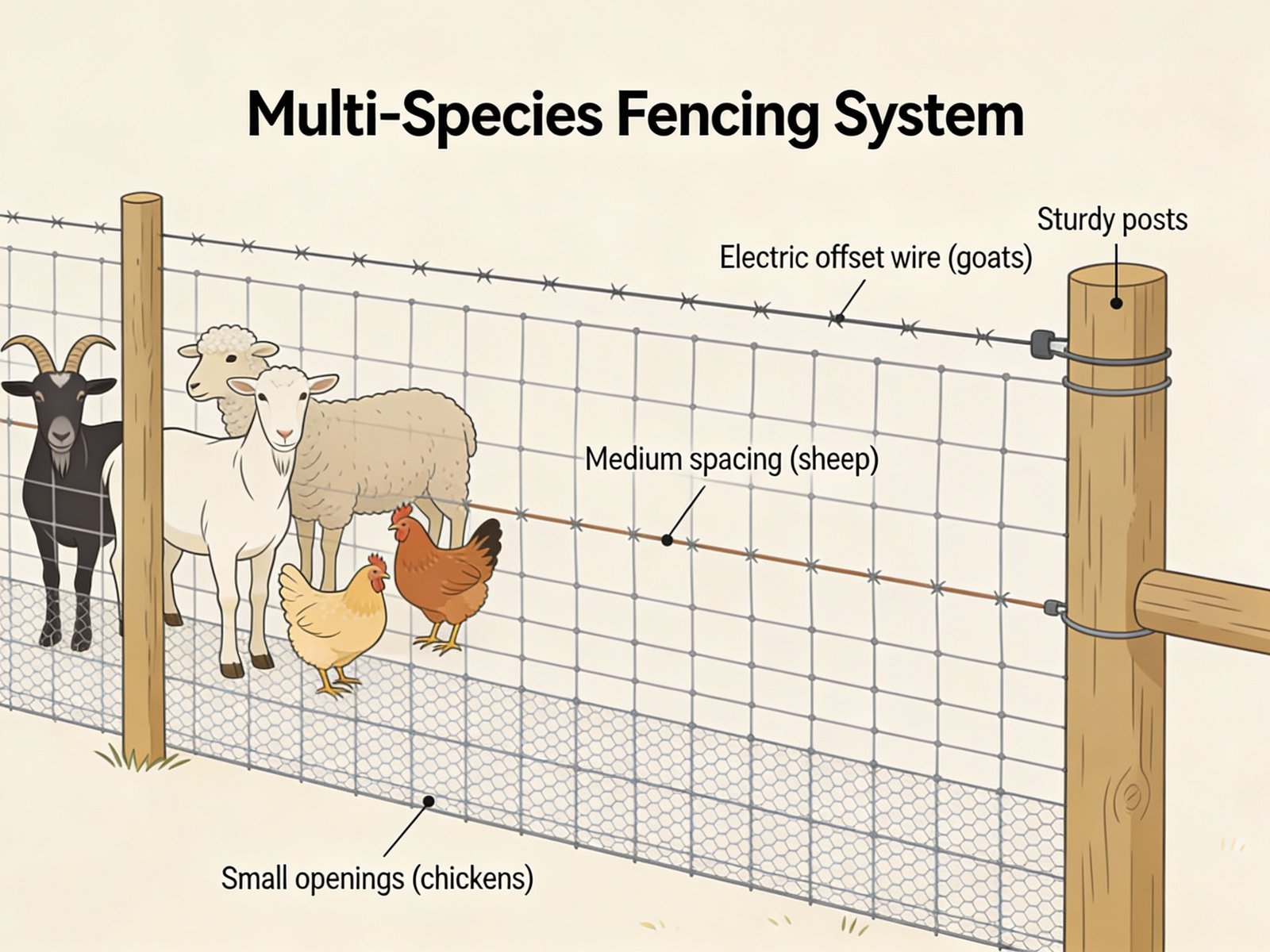
Yes, one fence type can work for goats, sheep, and chickens—but only with compromises. Tight woven wire or mesh fencing, often paired with electric offsets, is the most reliable single-system solution. It physically blocks chickens, resists sheep pressure, and discourages goats from climbing or pushing, without relying on animal training alone.
Why This Question Matters
Mixed-species fencing is one of the most common challenges on small and hobby farms. Goats test fences, sheep lean on them, and chickens slip through gaps most livestock fencing ignores. Many owners hope one fence can “do it all” to save money and labor—but the wrong choice leads to escapes, predator losses, or constant repairs. This question matters because while a universal fence can exist, it only works when designed around the most difficult animal, not the easiest one.
Key Factors to Consider
- Goats climb, push, and exploit weak points.
- Chickens require very small openings to prevent escape.
- Sheep apply steady pressure rather than impact force.
- Fence height, spacing, and grounding affect all three species differently.
Detailed Explanation
The reason a single fence can work lies in choosing a physical barrier that solves the smallest and most destructive behaviors at once. Chickens are the limiting factor for spacing, while goats are the limiting factor for strength. Woven wire or rigid mesh fencing addresses both by using tight openings and continuous structure rather than relying on tension alone.
Electric fencing by itself rarely succeeds across all three species. Chickens often ignore or bypass it, and goats quickly learn to test weak spots. However, electric offsets can be effective when added to physical fencing. A low hot wire discourages goats from leaning or climbing, while a higher offset reduces pressure at the top of the fence.
Fence height is another trade-off. A height sufficient for goats usually exceeds what sheep or chickens require. Choosing a taller fence upfront prevents later upgrades when goats inevitably challenge boundaries.
Finally, gates and corners must be built to the same standard as the fence itself. Most mixed-species failures happen at transition points—where mesh changes, spacing widens, or tension drops. A single fence system only works when every section is designed for the worst-case animal, not the average one.
Design Considerations
Why Goats Set the Design Standard
Goats are the primary reason universal fencing fails. They climb, rub, and exploit flexibility. Any fence that contains goats reliably will almost always contain sheep and chickens as a result.
Chicken Containment vs Predator Exclusion
Keeping chickens in often overlaps with keeping predators out. Smaller mesh sizes increase security but also increase material cost and installation time. This is where compromise decisions usually occur.
Electric Add-Ons vs Structural Strength
Electric wires improve performance but cannot replace physical structure. In mixed-species systems, electricity should support the fence—not define it.
When This Works Well
- Small farms with limited pasture divisions.
- Owners prioritizing simplicity over species-specific optimization.
- Permanent perimeter fencing rather than temporary paddocks.
- Predator pressure requiring tight openings anyway.
When This Is Not Recommended
- Farms with aggressive or large goat breeds.
- Operations needing frequent reconfiguration.
- Very large acreages where cost scales quickly.
- Situations where chickens free-range intentionally.
Alternatives or Better Options
Species-zoned fencing allows lighter fencing for sheep and chickens, with reinforced areas for goats. Double fencing systems separate goats from poultry while sharing perimeter infrastructure. Portable poultry fencing combined with permanent livestock fencing increases flexibility.
Cost, Safety, and Practical Notes
A single fence system often costs more upfront but reduces long-term complexity. Repair frequency drops when fences are built for goats rather than sheep. Safety improves because animals are less likely to escape into traffic, predators, or human areas. The real trade-off is not money versus performance—it’s simplicity versus optimization.
Quick Takeaway
One fence can work for goats, sheep, and chickens—but only if it’s designed for goats first and chickens second.