Short Answer
Sheep fencing on uneven or hilly terrain requires closer post spacing, flexible wire alignment, and strict ground contact. The fence must follow the land’s contours closely to prevent gaps underneath. Systems that work on flat ground often fail on slopes unless adjusted for elevation changes and pressure points.
Why This Question Matters
Hilly and uneven terrain is where otherwise “good” sheep fencing fails most often. Fences installed straight across slopes leave gaps underneath, lose tension unevenly, and create weak points sheep quickly exploit. Many producers underestimate how small elevation changes translate into crawl-under gaps or wire lift. On uneven ground, sheep escapes often begin quietly and escalate fast. This question matters because fencing mistakes on slopes are harder and more expensive to fix after livestock is present than during initial installation.
Key Factors to Consider
- Terrain changes create ground gaps that sheep readily exploit.
- Post spacing affects wire tension consistency on slopes.
- Fence flexibility determines how well it follows contour changes.
- Sheep pressure concentrates at dips, corners, and slope transitions.
Detailed Explanation
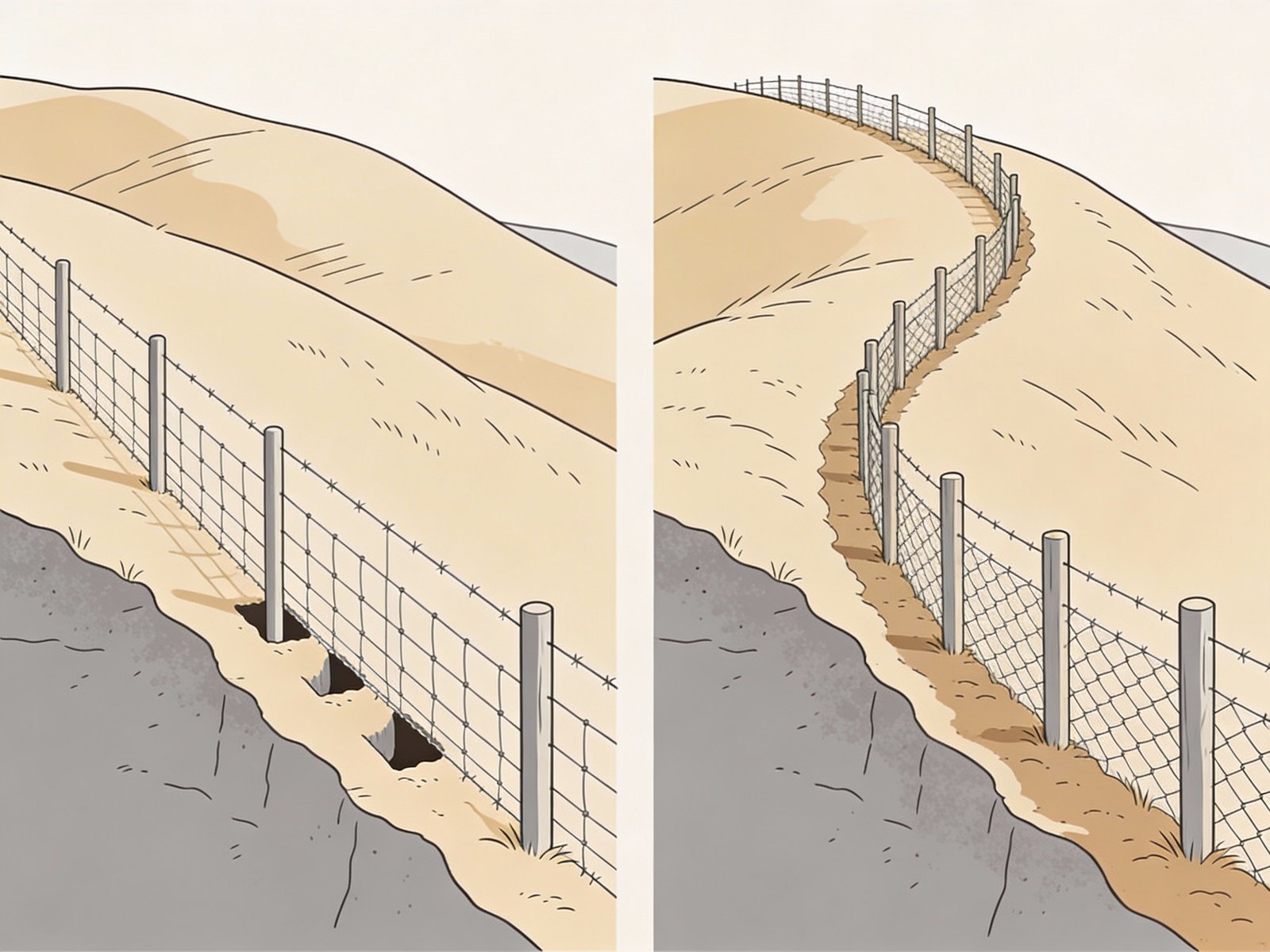
On uneven or hilly terrain, sheep fencing fails primarily due to poor ground contact. Unlike flat land, slopes and dips cause the fence line to lift off the soil unless it is carefully stepped or contoured. Even small gaps are enough for sheep—especially lambs—to crawl under. This makes following the terrain more important than maintaining perfectly straight fence lines.
Post spacing plays a larger role on slopes than on level ground. Wider spacing allows wire to sag downhill and lift uphill, creating uneven tension and ground gaps. Closer spacing helps anchor the fence to the terrain and reduces movement caused by gravity and animal pressure. On hillsides, fences that look tight at the top often loosen at the bottom if spacing is too wide.
Fence flexibility also matters. Rigid systems resist contour changes and tend to bridge over dips, while more flexible woven wire can be adjusted to follow uneven ground more closely. However, flexibility without sufficient support leads to sagging, so it must be paired with proper post placement and tensioning.
The key principle is that sheep fencing on uneven ground must be installed to the land, not to a straight line. Installations that prioritize visual straightness over ground contact almost always fail. Effective fencing anticipates movement, pressure, and soil variation rather than assuming uniform conditions.
Installation Approaches
Contour Following vs Straight-Line Fencing
Straight fence lines may look clean, but they are poorly suited to uneven terrain. When fences ignore contour changes, gaps form under the wire at low points and over tension builds at high points. Contour-following fences adjust wire height incrementally, keeping consistent ground contact. This approach reduces crawl-under opportunities and maintains more even tension across the entire run.
Pressure Points on Slopes and Dips
Sheep naturally congregate at easier travel routes—gentle slopes, dips, and transition points between elevations. These areas experience more foot traffic and fence pressure than straight, level runs. Without reinforcement, these zones become the first failure points. Tighter post spacing and additional ground control in these areas significantly improve fence reliability.
Soil Movement and Seasonal Changes
Uneven terrain often experiences more soil movement due to water flow, erosion, and freeze-thaw cycles. These forces gradually undermine posts and create new gaps under fences. A fence that works during dry conditions may fail after heavy rain or seasonal shifts. Accounting for long-term ground movement is essential when fencing hillsides.
When This Works Well
- Moderate slopes where posts can be set consistently and deeply.
- Permanent fencing designed specifically to follow terrain contours.
- Areas where pressure points are reinforced during installation.
- Operations that plan fencing layout before setting posts.
When This Is Not Recommended
- Attempting straight-line fencing across steep or irregular slopes.
- Wide post spacing carried over from flat-ground installations.
- Lightweight fencing systems with minimal ground control.
- Situations where erosion is ignored during design.
Alternatives or Better Options
Stepped fencing layouts adjust wire height in stages to match elevation changes without overstressing the fence. Closer post spacing in variable terrain improves ground contact and limits wire movement on slopes. Hybrid systems combine physical fencing with low electric offsets to discourage testing at unavoidable gaps.
Cost, Safety, and Practical Notes
Fencing uneven terrain costs more upfront due to additional posts, labor, and planning time. However, retrofitting fences after sheep escapes is typically far more expensive. Safety considerations include ensuring posts are stable on slopes and not prone to downhill movement. From a practical standpoint, most hillside fencing failures result from rushing layout decisions rather than material choice. Time spent aligning fences to terrain contours pays off in long-term reliability and reduced maintenance.
Quick Takeaway
On hills and uneven ground, sheep fencing succeeds only when it follows the land closely. Straight lines and wide spacing almost always lead to gaps—and escapes.