Short Answer
After soil erosion, reinforce fence posts if they remain structurally sound and firmly embedded below grade. Replace posts if erosion has exposed more than one-third of their depth, caused significant leaning, loosened the base, or weakened surrounding soil support. The decision depends on depth loss, stability, and long-term soil conditions.
Why This Question Matters
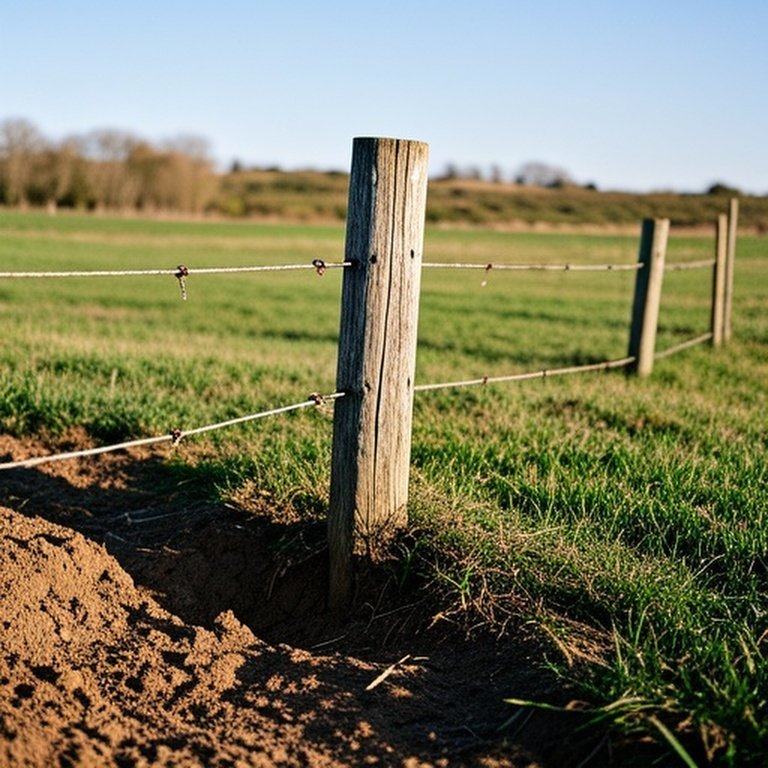
Soil erosion doesn’t just expose fence posts — it removes the structural support that keeps them stable. Even if a post appears upright, missing soil around its base reduces lateral resistance. Over time, wind pressure, livestock contact, or wire tension can cause failure.
Many fence owners reinforce posts that should actually be replaced, only to see recurring leaning months later. Others replace posts unnecessarily when simple soil rebuilding and compaction would restore stability.
Understanding whether the post’s integrity is compromised or only its surrounding soil is disturbed determines whether reinforcement is a durable fix or just a temporary patch. The wrong choice wastes labor and risks future structural failure.
Key Factors to Consider
- How much post depth is now exposed
- Whether the post base remains firm in soil
- Degree of leaning or structural shift
- Soil type and likelihood of continued erosion
- Load pressure from wire tension or livestock
Detailed Explanation
Fence posts rely on both depth and soil compaction for strength. Erosion removes lateral soil pressure — the very resistance that prevents posts from moving sideways under load. If erosion exposes only the top few inches and the buried section remains firm and below frost depth, reinforcement may be sufficient.
However, if one-third or more of the embedded depth is exposed, structural integrity is significantly reduced. Posts depend on underground leverage to resist tension. When too much depth is lost, simply packing soil back in rarely restores original strength, especially if erosion continues seasonally.
Leaning is another critical indicator. A post that moves easily when pushed likely has compromised footing. Reinforcing a loose post without reestablishing deep soil compaction often leads to repeated shifting. In these cases, removal and deeper reinstallation may be more reliable.
Soil type matters as well. Sandy or silty soils prone to runoff are more likely to erode again. Clay may hold temporarily but can crack or channel water during heavy rains. If erosion patterns are recurring, replacing the post and improving drainage or grading is often the more permanent solution.
Ultimately, reinforcement works when structural depth remains intact. Replacement is necessary when foundational depth and soil resistance are lost.
How Soil Support Affects Fence Strength
Posts resist sideways pressure because soil grips them below ground level. When erosion removes compacted soil, lateral strength drops significantly.
Rebuilding soil support must recreate depth and compaction — not just cover exposed areas.
When Reinforcement Is Enough
If erosion is shallow and the post remains firm when tested manually, adding gravel backfill and compacting in lifts can restore stability.
Reinforcement is effective only when underlying soil conditions are stable.
When Replacement Is the Safer Option
If the post rocks freely, leans significantly, or has lost substantial depth, replacement with deeper setting is the more durable fix.
Trying to reinforce a fundamentally unstable post often delays inevitable failure.
When This Works Well
- Minor erosion less than 6–8 inches
- Post remains firm when pushed
- No visible cracking or rot
- Soil can be compacted effectively
- Drainage improvements are implemented
When This Is Not Recommended
- More than one-third of post depth exposed
- Post leans more than a few degrees
- Soil remains loose or washes out repeatedly
- Corner or high-tension posts are affected
- Erosion occurs along slopes without grading
Alternatives or Better Options
Install Deeper Replacement Posts
Replacing with posts set below frost depth and erosion line provides long-term stability in vulnerable areas.
Add Gravel and Improve Drainage
Regrading slopes and adding gravel around bases reduces future soil loss.
Use Retaining or Soil Stabilization Methods
In high-runoff areas, consider small retaining edges or vegetation to stabilize surrounding soil.
Cost, Safety, and Practical Notes
Reinforcing a stable post is typically low-cost and labor-efficient. Replacement requires digging, resetting, and potentially re-tensioning wire, increasing time and material costs.
Safety is critical when working around tensioned wire. Release tension before removing or adjusting posts to prevent snap-back injuries.
Long-term durability depends on solving the erosion source — not just stabilizing the post. Without addressing runoff, grading, or drainage, repeated soil loss can undermine even newly installed posts.
Corner and brace posts deserve special attention. They carry high tension loads and should rarely be “patched” if structural depth is compromised.
Quick Takeaway
Reinforce fence posts after minor erosion if depth and stability remain intact. Replace posts when significant depth is lost, leaning occurs, or soil instability continues. The key decision factor is whether underground support still provides strong lateral resistance.