Short Answer
New small farm owners most often make fencing mistakes by choosing fences designed for the wrong livestock, underbuilding posts and spacing, ignoring ground gaps, relying too heavily on electric fencing, and prioritizing low upfront cost over durability. These errors lead to escapes, frequent repairs, and higher long-term costs.
Why This Question Matters
Fencing is usually one of the first major investments on a small farm—and one of the easiest to get wrong. New owners often copy what neighbors use, follow advice meant for larger operations, or focus on saving money upfront. The result is fencing that looks fine but fails under real animal pressure. Escapes, predator access, and constant repairs quickly turn excitement into frustration. This question matters because most fencing problems on small farms are predictable and avoidable once you know where beginners usually go wrong.
Key Factors to Consider
- Different livestock exploit fencing weaknesses in different ways.
- Small gaps cause more failures than low fence height.
- Installation quality often matters more than materials.
- Long-term maintenance is part of the true fence cost.
Detailed Explanation
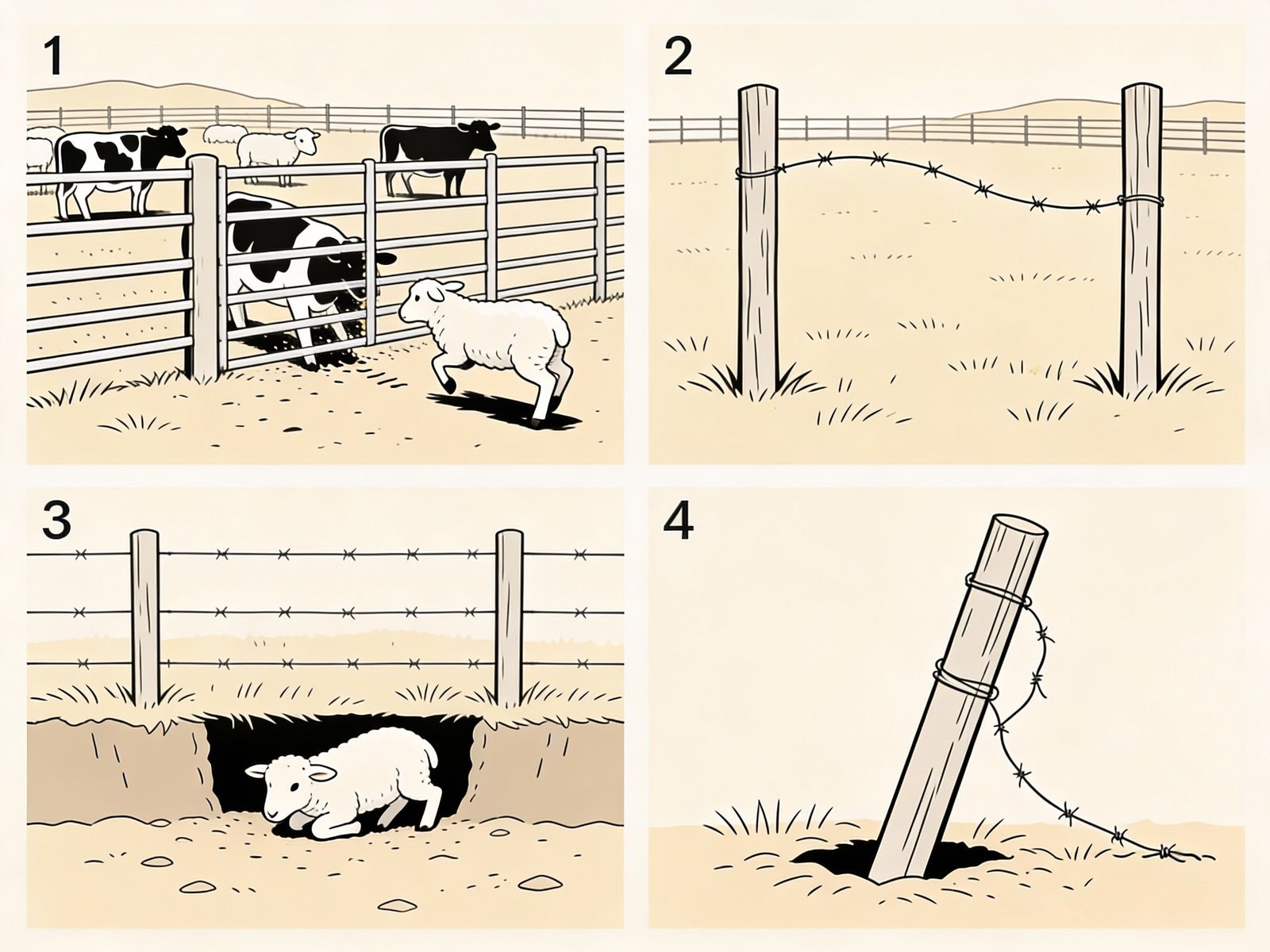
One of the most common mistakes new small farm owners make is choosing fencing based on appearance or price rather than animal behavior. Fences designed for cattle or horses often fail with sheep, goats, or poultry because wire spacing and ground control are inadequate. New owners assume “livestock fencing is livestock fencing,” only to discover species differences the hard way.
Another frequent mistake is underbuilding the structure. Posts set too far apart, set too shallow, or installed without accounting for terrain will loosen and shift over time. These structural shortcuts save money initially but create sagging wire, lifted fence lines, and repeated failure points that require constant attention.
Ground gaps are also routinely overlooked. New owners focus on fence height while ignoring what happens at ground level. Sheep, goats, and even pigs quickly exploit crawl-under spaces caused by uneven terrain, erosion, or poor installation. Once animals learn a gap exists, fixing the fence becomes harder than preventing the gap in the first place.
Finally, many beginners rely too heavily on electric fencing alone. While electric fencing can work, it depends on consistent power, proper grounding, and regular maintenance. When any of those slip, containment can fail suddenly. New owners often underestimate how much attention electric systems require and how quickly animals adapt when voltage drops.
Common Beginner Errors
Designing for the Most Problematic Animal
A common beginner mistake is designing fencing for the largest or calmest animal instead of the most escape-prone one. Goats, sheep, and poultry expose weaknesses much faster than cattle. If a fence holds the smallest and most agile animal, it will almost always hold the rest.
Mistaking “Temporary” for “Good Enough”
Many new farm owners assume early fencing is temporary and can be upgraded later. In practice, temporary fences often stay in place for years. Weak designs installed “for now” usually fail repeatedly and cost more to fix than building a durable fence from the start.
Overestimating Available Time
New owners often assume they will have time to constantly monitor and adjust fences. As daily farm tasks increase, fencing maintenance drops. Systems that require perfect upkeep often fail simply because real life intervenes.
When This Works Well
- New owners willing to plan fencing before buying materials.
- Farms that design fences for the smallest or most active livestock.
- Permanent installations built with realistic maintenance expectations.
- Situations where perimeter fencing is prioritized early.
When This Is Not Recommended
- Rushing fencing decisions after livestock arrives.
- Copying neighboring farms without matching livestock needs.
- Choosing materials solely based on lowest upfront cost.
- Relying on electric fencing without backup containment.
Alternatives or Better Options
Sheep- or goat-specific fencing designs reduce common beginner mistakes by controlling spacing and ground gaps. Hybrid fencing systems combine physical barriers with electric reinforcement to limit testing behavior. Phased fencing plans allow new owners to build strong perimeters first and upgrade interiors later.
Cost, Safety, and Practical Notes
Most fencing mistakes cost more to fix than to avoid. Rebuilding failed sections, replacing animals, or repairing neighbor relations adds hidden expenses. Safety issues include animals becoming trapped in poorly sized openings or escaping into traffic areas. In practice, experienced small farm owners consistently report that underbuilding fences is one of their biggest early regrets. Conservative design is usually the safer and cheaper choice.
Quick Takeaway
Most fencing failures on small farms aren’t bad luck—they’re repeatable beginner mistakes. Designing for behavior, structure, and reality prevents nearly all of them.