Short Answer
Permanent fencing is generally better for young livestock. It provides consistent physical containment, reduces escape risk during early growth stages, and does not rely on animal training or constant adjustment. Temporary fencing can work in limited, well-managed situations, but it carries higher failure risk when used as a primary barrier for young animals.
Why This Question Matters
Temporary fencing is attractive because it’s flexible, fast to install, and often cheaper upfront. Many producers assume it’s a safe way to “start small” with young animals. The problem is that young livestock are still learning boundaries, testing limits, and behaving unpredictably. When temporary fencing fails, it doesn’t just cause a one-time escape—it teaches animals that boundaries are negotiable. This question usually comes up after repeated breakouts, fence repairs, or predator scares, when it becomes clear that flexibility has turned into instability. Choosing the wrong fence type early creates problems that persist long after animals grow.
Key Factors to Consider
- Reliability of the fence without daily adjustment
- Ability to physically block pushing, leaning, and crawling
- Tolerance for early-stage animal mistakes
- Risk and impact of fence failure
- Long-term management and labor demands
Detailed Explanation
The core difference between temporary and permanent fencing is how much margin for error they allow. Young livestock need a system that works even when animals behave imperfectly—which they do constantly during early stages. Permanent fencing provides that margin by relying on physical structure rather than behavior.
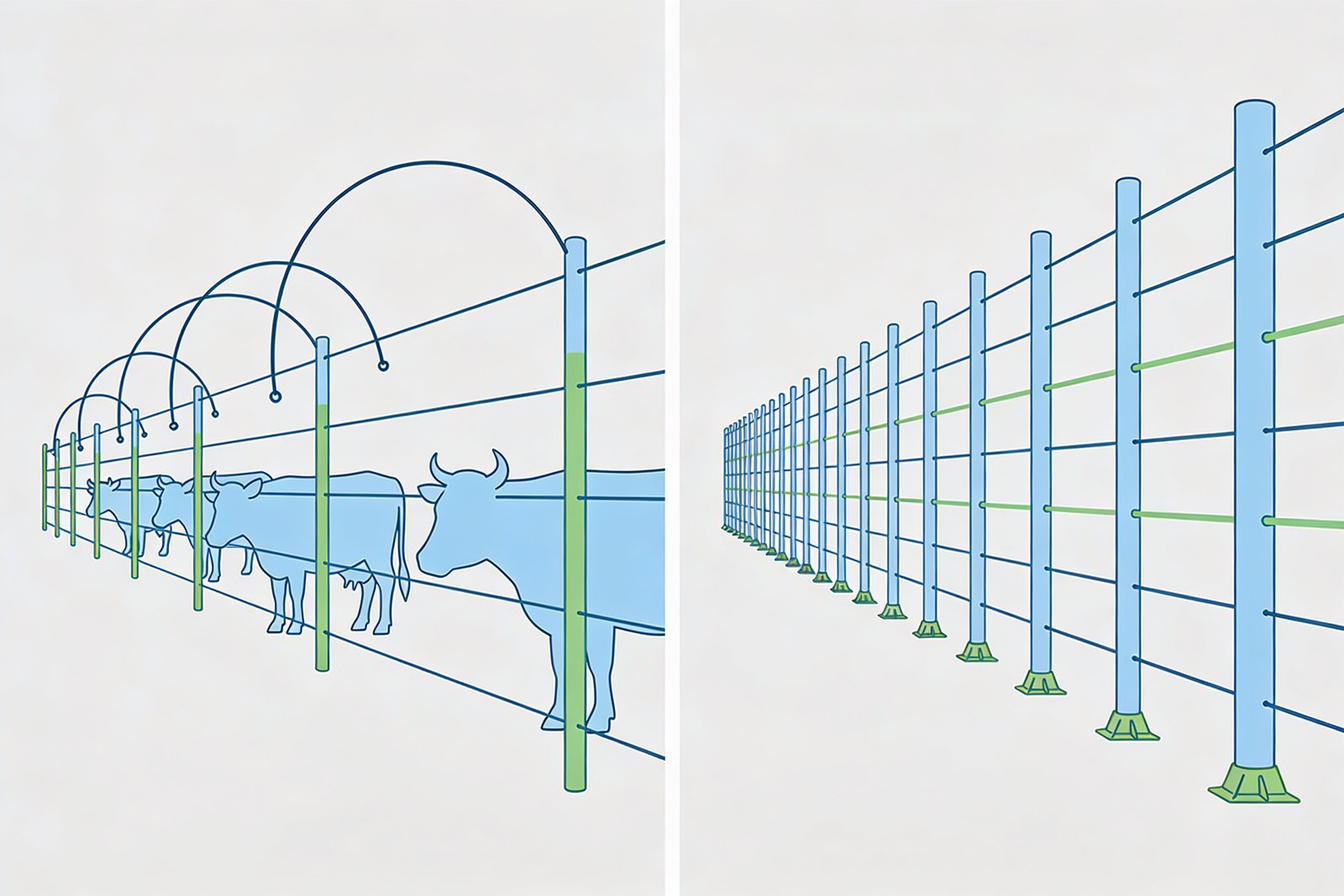
Temporary fencing often depends on light posts, flexible materials, or psychological deterrence. These systems can hold trained animals but are far less forgiving when young livestock push, climb, or follow each other into pressure points. When a temporary fence shifts, sags, or loses tension, openings appear quickly and repeatedly.
Permanent fencing resists these behaviors by maintaining consistent spacing, height, and ground contact. It does not require animals to “learn” boundaries correctly from the start. This is especially important early on, because young animals form habits fast. A single successful escape through a temporary fence often leads to repeated attempts at the same location.
Another difference is failure mode. Temporary fencing tends to fail suddenly—posts pull out, lines drop, or sections collapse. Permanent fencing degrades more gradually, showing warning signs before full failure. That gives operators time to intervene before escapes or injuries occur.
This does not mean temporary fencing has no place. It means it performs best when animals already respect boundaries, escape consequences are low, and supervision is high. For young livestock, especially in perimeter or overnight situations, permanent fencing reduces both immediate risk and long-term behavioral problems.
Behavioral and Management Considerations
Learning Behavior and Boundary Formation
Young livestock are actively learning how the environment responds to their actions. When they push a fence and nothing happens—or the fence moves—they interpret that as permission to continue. Temporary fencing is more likely to provide these ambiguous signals.
Permanent fencing gives consistent feedback. Animals encounter resistance immediately and uniformly, which discourages testing. Over time, this reduces fence pressure instead of increasing it.
Once animals learn that boundaries are solid, lighter or more flexible systems become viable. But using temporary fencing too early places the burden on behavior before animals are ready to meet it.
Management Intensity and Failure Consequences
Temporary fencing assumes frequent inspection and adjustment. Voltage drops, posts shift, and tension changes with weather and animal contact. This level of management can work—but only if failure consequences are low.
With young livestock, failure consequences are high. Escapes increase predator exposure, injury risk, and stress. Permanent fencing reduces reliance on daily perfection and shifts the system toward stability rather than vigilance.
When This Works Well
- Primary perimeter fencing for young livestock
- Overnight containment without constant supervision
- Operations prioritizing low escape risk
- Long-term pasture or enclosure planning
When This Is Not Recommended
- Short-term training or supervised daytime use
- Situations requiring frequent fence relocation
- Low-risk interior fencing within secure perimeters
- Temporary paddocks with trained animals
Alternatives or Better Options
Hybrid systems combine permanent perimeter fencing with temporary interior fencing. This allows flexibility without compromising security during early stages.
Portable panels can work for confined spaces but scale poorly to larger areas.
As animals mature, temporary fencing becomes more effective, especially for rotational grazing. The key is sequencing—stability first, flexibility later.
Cost, Safety, and Practical Notes
Permanent fencing costs more upfront, but it reduces cumulative losses from escapes, repairs, and labor. Over time, it often becomes the lower-cost option.
From a safety perspective, stable fencing reduces panic-driven injuries caused by partial failures. Temporary systems fail more unpredictably, increasing risk during early growth stages.
Practically, starting with permanent fencing simplifies management. Temporary fencing can always be added later, but correcting early failures is far more difficult than preventing them.
Quick Takeaway
For young livestock, stability matters more than flexibility—permanent fencing creates habits you don’t have to fix later.