Plan the tensioning operation
Overview
Wire stretching removes slack and establishes the installed tension specified for the particular product. Smooth high-tensile wire, barbed wire and woven mesh require different gripping methods and instructions. Do not use one tension figure for all products.
This guide explains tension specifications by wire type, proper stretching tools and techniques, temperature compensation strategies, re-tensioning methods for sagging fence lines, and common tensioning mistakes preventing optimal performance. It is designed for DIY farmers, ranch owners, and fence installers building or maintaining wire-based livestock containment systems. Content focuses on practical methods achieving proper tension using standard equipment rather than specialized commercial tools. This page assumes basic understanding of fence post installation and corner bracing—complete fence installation fundamentals are covered in separate comprehensive guides.
What This Guide Covers
How to Properly Tension Fence Wire
Use the manufacturer’s installed-tension specification and measuring method for the exact wire product. Hand pressure or a musical note is not a reliable tension measurement. Check the wire grade, diameter, construction and bracing before applying load.
Tension wire when ambient temperature is in the middle of the expected seasonal range for your region. Wire installed at maximum tension in summer will over-tighten and possibly break during cold winter contraction; wire installed at maximum tension in winter will go slack in summer heat expansion. Installing at the temperature midpoint, then adjusting with in-line strainers seasonally, maintains appropriate tension year-round.
Using a Fence Stretcher Correctly
A fence stretcher (come-along or ratcheting fence puller) grips the wire and applies mechanical advantage to pull it to proper tension before stapling or clipping. Attach the stretcher to the fence wire using fence stretcher clamps — not pliers or wire wrapped around the come-along hook, which can slip under load. Apply tension gradually rather than in one rapid pull; gradual tensioning allows the wire to seat properly and lets you feel when appropriate tension is reached.
For woven wire fence, the fence stretcher attaches to a wooden stretcher bar (a 2x4 or similar) threaded through the mesh vertically, distributing the pulling force evenly across all horizontal wires simultaneously. Pulling from a single wire strand on woven wire distorts the mesh. After reaching proper tension, staple the wire to every post before releasing the stretcher — wire that is stapled only at ends without intermediate attachment will sag between posts.
High-Tensile Wire and In-Line Strainers
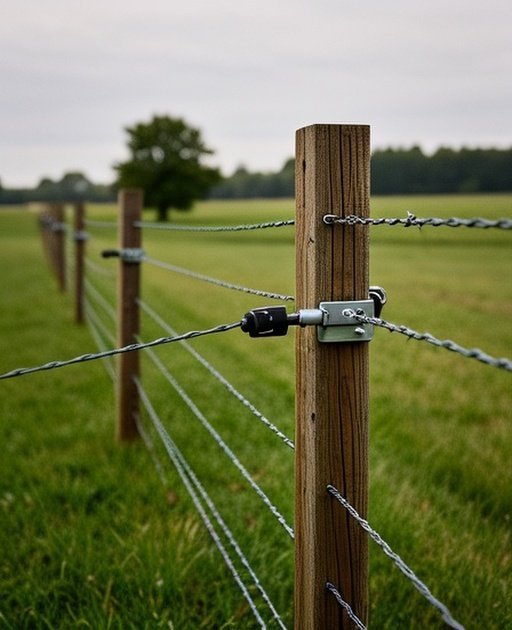
In-line strainers (also called ratchet strainers or wire tighteners) are essential for high-tensile wire installations. These small ratcheting devices are crimped into the wire mid-span, allowing tension to be adjusted without cutting the wire. Install one in-line strainer per wire strand per fence run of 400 feet or more. Place strainers near the mid-point of the run for access during seasonal adjustment. Tighten strainers in spring when wire has expanded in summer heat; loosen slightly in fall before winter cold contracts the wire.
High-tensile wire requires crimping tools for making secure loops and terminations — a proper crimp maintains 95%+ of wire strength, while a hand-tied knot retains only 50–60% of wire strength. Always use the appropriate ferrule/sleeve size for 12.5-gauge high-tensile wire and a properly sized crimping tool. Undersized crimps slip under tension; oversized crimps don't grip adequately. The correct tool for the wire size is the single most important variable in secure high-tensile wire connections.
Common Tensioning Mistakes
Excessive tension can damage wire, connectors and posts. There is no universal load at which every high-tensile or standard wire deforms. Stop if wire breaks or hardware shifts, and inspect the complete assembly before resuming.
Under-tensioning creates sagging fence that livestock push down and predators push through. Wire that bounces and moves when livestock lean on it teaches them that the fence yields — animals then apply progressively more pressure. Properly tensioned wire that deflects minimally under livestock pressure teaches the fence boundary is firm, creating consistent behavioral response. Check wire tension annually in fall before seasonal tightening is needed.
Tensioning Woven Wire Fence
Woven wire (field fence) must be stretched as a unit rather than strand by strand. The process: unroll the woven wire along the fence line, attach the end to a corner post with staples or clips, walk to the opposite end of the section (maximum 330 feet per pull), thread the stretcher bar through the mesh, and apply tension with a come-along until the mesh is taut and the bottom wire contacts the ground evenly. Then staple to every post from the corner back to the stretcher.
Woven wire that is stretched properly has a uniform appearance — mesh squares of consistent size, bottom wire following the ground contour without gaps or slack, and no visible sag between posts. A poorly stretched section that sags mid-span will be immediately obvious and should be re-done before the fence is put into service. Re-doing a section during installation costs an hour; re-doing it after animals have learned to push through costs the re-tensioning work plus retraining effort.
How Tight Should Fence Wire Be?
How tight fence wire should be varies by type and application—high-tensile smooth wire requires 200-250 pounds tension p
Read more →
📐
Best Tools for Stretching High-Tensile Wire
Best tools for stretching high-tensile fence wire include ratchet-style fence stretchers providing controlled gradual te
Read more →
⚡
Using a Fence Stretcher Without Damaging Wire
Using a fence stretcher without damaging wire requires proper attachment techniques using stretcher grips designed for w
Read more →
🐎
Can You Over-Tighten Fence Wire?
Yes, over-tightening fence wire causes damage including wire breakage from excessive stress, premature metal fatigue red
Read more →
🌿
How to Re-Tension a Sagging Fence Line
Re-tensioning a sagging fence wire line begins with identifying sag causes—loose wire from inadequate initial tension, p
Read more →
🔧
Proper Tension for Woven Wire Fence
Proper woven wire fence stretching requires specialized techniques preventing mesh distortion—stretch gradually from one
Read more →
💰
Temperature Changes and Wire Expansion
Temperature changes significantly affect fence wire tension through metal expansion and contraction—wire expands when he
Read more →
📋
Electric Fence Wire Tension Guidelines
Whether electric fence wire should be stretched tight or slightly loose depends on conductor type and fence design—perma
Read more →
🏗️
Inline Tensioners and Adjustment Systems
Installing inline wire tensioners provides ongoing adjustment capability compensating for wire elongation, temperature-i
Read more →
🛡️
Corner Post and Brace Assembly Requirements
Proper wire tension demands adequate corner post and brace construction withstanding cumulative wire loads—high-tensile
Read more →
Common Decision Scenarios
If your existing wire fence is sagging
Sagging wire fence can often be re-tensioned without full replacement if the posts are sound and the wire is not broken or severely rusted. Walk the fence and check posts first — a leaning corner post is the source of multiple-section sag and must be rebuilt before wire re-tensioning will hold. For individual sections with sound posts, use a fence stretcher to re-tension and re-staple the sagging wire.
If re-tensioning the same section is needed more than once per season, the root cause is structural — either the posts are moving, the wire is too light for the application, or the corner bracing is inadequate. Address the structural problem rather than repeatedly re-tensioning. Repeated re-tensioning of standard wire eventually over-stretches it beyond recovery; at that point, replacement is the only option.
If you're choosing between standard wire and high-tensile
For any new fence installation over 300 feet in length, high-tensile wire is the better choice for longevity and low maintenance. High-tensile wire holds tension through seasonal temperature changes without requiring restapling or retensioning; standard wire stretches and sags annually as posts shift and wire fatigues. The initial learning curve for high-tensile installation (crimping tools, in-line strainers) is modest and pays back quickly through reduced annual maintenance.
Standard wire is appropriate for small, short fence runs where the simpler installation outweighs the long-term advantages of high-tensile. A 100-foot garden fence or a small paddock enclosure doesn't justify the high-tensile installation learning curve. For any fence expected to serve for more than 10 years on a working farm, high-tensile wire is the better long-term investment.
If Your Fence Is Sagging After Winter
Post-winter fence sagging typically results from temperature-induced wire contraction during cold months followed by spr
Read more →
📐
If Livestock Are Leaning on the Fence
Livestock leaning, rubbing, or scratching against fences creates progressive tension loss through wire stretching and po
Read more →
⚡
If You’re Installing High-Tensile Wire for the First Time
First-time high-tensile wire fencing installations demand understanding system differences from traditional barbed wire—
Read more →
🐎
If You Want Low-Maintenance Tension Systems
Low-maintenance tension systems incorporate inline wire tensioners enabling periodic adjustments without complete re-str
Read more →
Key Design & Planning Considerations
Wire Type and Required Tension
Record the product, grade, diameter and manufacturer’s installed-tension requirement before choosing tools. Smooth wire uses compatible wire grips; woven mesh requires load distributed across its height using the specified stretcher equipment. A smooth-wire tension value is not a target for an entire mesh roll.
Fence Height & Spacing
Fence height and wire spacing affect tension requirements and post loading—taller fences create greater leverage multiplying lateral forces on posts demanding stronger installations, multiple wire strands accumulate tension requiring reinforced corner assemblies, and wider post spacing increases wire span requiring greater tension preventing excessive mid-span sag. Post spacing standards vary by fence type—high-tensile systems permit 15-20 feet through superior tension capabilities while traditional wire requires 12-16 feet preventing sag. Balance height and spacing with structural capacity ensuring corner posts and braces withstand cumulative wire loads without failure.
Post Stability and Bracing
Wire tension effectiveness depends entirely on adequate fence post installation providing stable anchors resisting pulling forces—corner posts must be set deeper (36-48 inches minimum) using larger diameter wood (6-8 inches) or steel pipe, reinforced with H-braces or double-brace assemblies distributing tension loads, and potentially concrete-set in challenging soils. Line posts require adequate spacing and depth preventing leaning under wire pressure. Proper tensioning on inadequate posts causes progressive structural failure—corner pulling, post leaning, and brace breakage requiring expensive repairs. Verify post installation meets specifications before wire stretching preventing wasted effort tensioning systems lacking structural capacity maintaining proper tightness.
Safety Factors When Stretching Wire
Wire stretching creates significant injury risks demanding safety precautions preventing accidents—taut wire under high tension stores dangerous energy releasing suddenly if wire breaks or attachments fail, stretching equipment can slip causing violent recoil injuring operators, and wire under tension poses laceration hazards from sharp ends and barbs. Essential safety practices include wearing heavy leather gloves and eye protection, positioning body clear of wire recoil paths, using rated equipment appropriate for loads, applying tension gradually testing system integrity, and maintaining awareness of wire location preventing accidental contact. Never stand directly in line with tensioned wire—position perpendicular to wire direction minimizing injury risk if breakage occurs. Prevent installation injuries through proper technique and protective equipment rather than accepting preventable accidents.
Long-Term Maintenance Planning
Wire tension maintenance schedules balance proactive adjustments with practical labor availability—high-tensile systems benefit from annual spring re-tensioning compensating for winter contraction and permanent elongation, traditional wire fences require inspection-based re-tensioning when sag becomes visible affecting containment, and electric systems demand tension sufficient preventing ground contact but tolerate more sag than physical barriers. Integrate tension checks with regular fence inspection schedules maximizing efficiency—quarterly walks identifying developing sag enable prompt adjustment preventing complete failure. Budget ongoing maintenance costs including periodic re-tensioning as normal operational expense rather than deferrable work—proper tension maintenance extends fence lifespan significantly through reduced wire fatigue and post stress.
Related Fence Systems
Frequently Asked Questions
How tight should high-tensile fence wire be?
Use the installed-tension value and indicator specified for the exact wire product. “High-tensile” alone does not define a universal setting. Do not judge tension by plucking the wire or confuse breaking strength with working tension.
Can you stretch fence wire without professional tools?
Use purpose-built tensioning equipment rated for the load and compatible with the wire. Do not use a tractor or another vehicle to pull the fence tight. Bekaert’s high-tensile installation guide calls for proper tensioning tools, protective equipment and controlled uncoiling. This older guide is a safety reference, not a substitute for current product instructions.
Before applying load
- Confirm the product’s installed tension and measuring method.
- Inspect end posts, corner braces, wire and connectors.
- Use compatible grips and keep people and animals clear of the recoil path.
- Stop if a brace moves, a clamp slips or wire is damaged.
What happens if fence wire is too tight?
Excessive tension can break wire, damage connectors or move posts. Follow the product’s working-tension instructions. If the fence is damaged or supports move, stop and correct the cause before retensioning.
Does cold weather loosen fence tension?
No, cold weather actually increases fence tension as wire contracts with decreasing temperatures—steel wire shortens approximately 1 inch per 100 feet per 50°F temperature drop. This creates tighter tension potentially causing over-stressed wire breakage if initial tensioning was excessive. Conversely, hot weather loosens tension as wire expands. Install fences at moderate temperatures (50-70°F) allowing balanced expansion and contraction ranges preventing temperature-extreme failures. Spring re-tensioning addresses winter contraction effects.
How often should fence wire be re-tensioned?
Fence wire re-tensioning frequency depends on wire type and conditions—high-tensile systems benefit from annual spring adjustments compensating for winter contraction and permanent elongation, traditional wire requires inspection-based re-tensioning every 2-5 years when visible sag develops, and new fences need initial re-tensioning after 6-12 months as systems settle. Heavy livestock pressure areas demand more frequent attention. Integrate checks with regular fence inspections identifying developing problems enabling prompt correction.
Final Recommendations
Wire stretching and tensioning represents critical livestock fence installation and maintenance skill determining system effectiveness, structural longevity, and operational performance. Best for traditional wire fence systems including barbed wire, high-tensile smooth wire, and woven wire mesh requiring proper tension maintaining containment and preventing premature deterioration. Not applicable to board fencing, PVC systems, or decorative residential fencing where tension proves irrelevant.
Master proper tensioning techniques before attempting fence installation—inadequate tension creates progressive sag and livestock escape while over-tensioning causes wire breakage and structural failure. Invest in appropriate stretching tools including tension indicators ensuring specifications are met rather than relying on guesswork producing inconsistent results. Next recommended reading includes comprehensive fence repair guides addressing tension loss and structural problems, high-tensile wire systems for premium installations, and post installation fundamentals providing structural foundation supporting proper wire tension throughout decades of service.