
Short Answer
For most farm and livestock fencing, fence posts should be spaced 8 to 12 feet apart for standard line posts. High-tensile wire may allow spacing up to 20–30 feet with proper bracing, while woven wire and livestock-heavy areas typically perform best at 8–10 feet. Corner and gate posts require reinforced bracing regardless of spacing.
Why This Question Matters
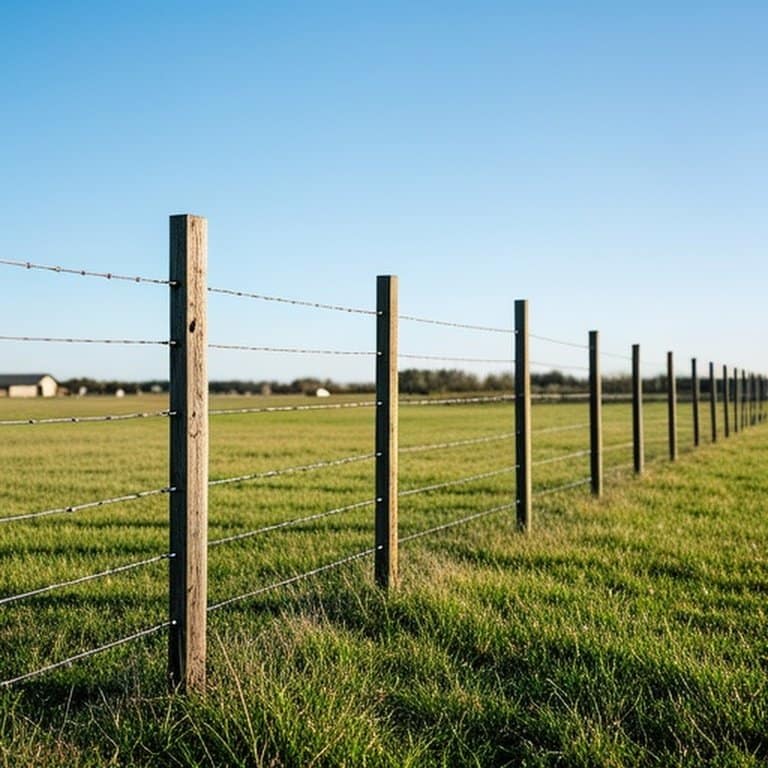
Post spacing directly affects fence strength, durability, cost, and long-term maintenance. Wider spacing reduces material and labor costs, but it also increases wire sag, strain on posts, and vulnerability to livestock pressure. Spacing that is too narrow increases costs without adding meaningful strength.
The correct spacing depends on fence type, wire tension, livestock behavior, terrain, and climate conditions. A fence built for cattle on flat, open pasture has different structural demands than one containing goats on uneven terrain. Choosing proper spacing ensures wire tension remains stable, posts resist leaning, and the fence line stays straight over time. Get spacing wrong, and you may face premature repairs, sagging wire, or structural failure.
Key Factors to Consider
- Type of fencing material used (woven, barbed, high-tensile)
- Livestock size and behavioral pressure
- Soil stability and drainage conditions
- Terrain slope and wind exposure
- Line posts versus corner and gate anchors
Detailed Explanation
Standard agricultural fencing typically uses 8 to 12 feet spacing for wooden line posts. This range balances structural stability and cost efficiency. At 8–10 feet, woven wire remains tight, resists sagging, and handles livestock leaning more effectively. As spacing increases beyond 12 feet, wire tension becomes more critical and sag risk increases, particularly with woven fencing.
High-tensile fencing systems operate differently. Because the wire is tensioned tightly and supported by brace assemblies, posts can often be spaced 20–30 feet apart. However, this works only when corner and end braces are properly constructed. Without strong anchor systems, increased spacing leads to structural failure under tension.
Livestock pressure also matters. Mature cattle apply repeated lateral force when leaning or rubbing. Tighter post spacing distributes that pressure more evenly. In contrast, perimeter fencing for lighter livestock or low-pressure areas may tolerate slightly wider spacing without performance loss.
Terrain plays an equally important role. Sloped or uneven ground requires closer spacing to maintain ground contact and fence alignment. Wind-exposed areas also benefit from tighter spacing to prevent oscillation and loosening over time.
In practical farm fencing, 8–10 feet remains the safest and most widely used standard for woven and barbed wire. Wider spacing should only be used when structural design supports it.
How Cattle Behavior Affects This Choice
Cattle lean, scratch, and push against fence lines, especially near feeding or watering areas. In high-pressure zones, closer post spacing improves resistance to repeated force. Wider spacing increases stress on individual posts, raising the risk of leaning and loosening over time.
For cattle-heavy environments, 8-foot spacing often performs better than 12-foot spacing in long-term durability.
Calves vs Mature Cattle Considerations
Calves apply minimal structural pressure, so slightly wider spacing may perform adequately in low-density areas. Mature cattle, however, create consistent lateral stress. Heavier animals require stronger structural support, often achieved with closer post intervals and reinforced bracing.
Fence design should anticipate herd growth rather than current livestock size.
Terrain, Visibility, and Pressure Zones
Uneven terrain demands tighter spacing to maintain fence alignment and ground contact. In flat open fields, spacing can be slightly wider without compromising structural integrity.
High-traffic areas such as gates, corners, feeding zones, and water access points require stronger anchoring and often closer spacing regardless of general fence layout.
When This Works Well (8–10 Feet)
- Woven wire livestock fencing
- Cattle or mixed herd environments
- Moderate wind exposure regions
- Sloped or uneven terrain
- Long-term durability priority over minimal cost
When This Is Not Recommended (Wide Spacing)
- Heavy livestock pressure areas
- Poor soil stability or drainage
- High wind regions
- Woven wire without high-tension support
- Gate-adjacent sections requiring added strength
Alternatives or Better Options
High-Tensile System with Wide Spacing
Allows posts every 20–30 feet when strong brace assemblies anchor tension. Best for large open pasture systems.
Steel T-Posts with Wood Anchors
Combining steel line posts spaced 8–12 feet apart with braced wooden corners improves efficiency and durability.
Hybrid Spacing Strategy
Use tighter spacing in high-pressure areas and standard spacing elsewhere to optimize both cost and strength.
Cost, Safety, and Practical Notes
Closer spacing increases material and labor costs but reduces long-term maintenance. Wider spacing lowers upfront expense but may increase sagging and repair frequency. The true cost difference becomes evident over years, not during installation.
Safety considerations include ensuring posts are properly set below frost depth and that brace assemblies are secure before tensioning wire. Improper spacing can cause structural imbalance, increasing the risk of collapse under tension or animal pressure.
In practical farm construction, spacing consistency is as important as spacing distance. Uneven intervals create tension irregularities that weaken the system.
The most reliable general recommendation for livestock fencing remains 8–10 feet for standard line posts, with reinforced corners and gates.
Quick Takeaway
For most farm fences, spacing posts 8–10 feet apart provides the best balance of strength, cost, and durability. Wider spacing works only with proper high-tensile systems and strong bracing. When in doubt, prioritize structural stability over minimal material savings.